
New York State mold laws come down mostly to one statute: Article 32 of the New York Labor Law. It is a licensing law. It requires the companies and the workers who assess and remove mold to hold a state license and to follow a set of minimum work standards. The New York State Department of Labor administers it. It applies everywhere in the state, not only in New York City, and the licensing requirement has been in effect since January 1, 2016.
Article 32 controls who is allowed to do the work. It does not require you to inspect your property for mold, and it does not require you to remove mold you find. The duties owners usually attribute to Article 32 come from somewhere else. Inspecting a building every year comes from New York City’s housing rules. Correcting a tenant’s mold condition comes from those rules and from the warranty of habitability in your leases.
At Dry Ease Mold Removal, we work as the licensed remediation contractor on mold projects in New York City and the surrounding counties. We have served more than 50,000 families, property managers, and building owners across the New York metropolitan area. Owners and managers ask us the same question constantly. The state licensing law, the city housing rules, and the lease itself all say something about mold. They want to know which one is creating the duty they have to meet.
Are You the Tenant or the Owner?
If you are a tenant with mold in your apartment, tell your landlord about it first. If it does not get fixed, you can file a complaint through 311, online or by phone, and the city sends it to the Department of Housing Preservation and Development for an inspection. The state licensing law is written for the companies doing the work, so it says very little about what your landlord owes you.
If you own or manage the building, the rest of this is written for you.
What Happens After a Tenant Reports Mold?
Before anyone inspects, no city correction deadline has started. That deadline starts only if an HPD inspector writes a violation on the unit.
Inspecting the unit is your job in the meantime. If your building has three or more apartments, New York City requires the owner to inspect whenever a tenant complaint or an HPD notice points to a possible mold problem. Nobody has to send you a violation first.
You cannot control when that deadline starts. A tenant who is not satisfied can file a 311 complaint at any point, and HPD sends an inspector. So the sooner you inspect and start the work, the more of it you finish before a deadline exists.
If that inspector writes a mold violation, the time you get depends on how the violation is classed. Mold is not automatically the most severe class. HPD issues it as either Class B, which is hazardous, or Class C, which is immediately hazardous. Class B carries 30 days to correct the condition. Most Class C conditions carry 24 hours, but mold is one of the exceptions, and a Class C mold violation carries 21 days.
Read the class off the notice before you plan anything. On a job that needs licensed companies, the work happens in a set order rather than all at once. A licensed assessment company writes the remediation plan first. A separate licensed remediation contractor then does the work. The assessment company issues a clearance notice at the end.
After that you certify the correction, which means filing a statement with HPD that the condition has been fixed. You back that statement up with the paperwork from the job.
Start by looking at the unit and measuring the affected area. That measurement decides which set of rules you are working under.
Which New York Mold Rules Apply to Your Building?
Four separate rules can apply to a mold problem in a New York building. They cover different buildings and require different things.
| Rule | What it is | Who it applies to | What it requires | Who enforces it |
|---|---|---|---|---|
| NY Labor Law Article 32 | State licensing law for mold work | Any business doing mold work on an area over 10 square feet, anywhere in New York | Licensed assessor plus a separate licensed remediation contractor, written plan, containment, clearance notice | NYS Department of Labor |
| NYC Local Law 55 | City housing rule on mold and pests | NYC residential buildings with 3 or more apartments | Yearly inspections, inspection after a complaint, fix the moisture source, safe work practices, state-licensed pros once the mold exceeds 10 square feet | HPD |
| NYC Local Law 61 (Admin Code 24-154) | Notice and filing rule for licensed mold work | Buildings with 10 or more units, or 25,000 or more square feet of non-residential floor area on the zoning lot | Contractor notice 2 business days before work starts, assessor’s report filed within 7 days | DEP and HPD |
| Warranty of habitability (Real Property Law 235-B) | Implied promise in every residential lease | Every residential landlord in New York State | Keep the unit fit to live in, which means addressing mold and the moisture behind it | Tenant claims in court |
How Much Mold Requires a Licensed Contractor in New York?
More than 10 square feet of mold requires a licensed contractor in New York. The statute regulates a “project,” which it defines as mold assessment, remediation, or abatement covering an area greater than 10 square feet. A job at exactly 10 square feet or smaller is not a project, so the law does not require a licensed company to do it.
What you measure is the affected area itself, not the room it sits in. A patch three feet by three feet is nine square feet, which is below the threshold. A patch four feet by four feet is 16 square feet, which is above it. Routine cleaning does not count toward that measurement, and neither does construction or repair work that has nothing to do with mold.
At 10 square feet or smaller, the state does not require licensed people, so your own maintenance staff or any contractor you use can do the work. In a New York City building with three or more apartments, you still have to fix the moisture source and follow the city’s safe work practices.
We do add one caution from our own jobs. Mold on a wall usually starts with water behind the wall, so the growth you can see is often smaller than the growth you cannot. If your measurement is anywhere near 10 square feet, have a licensed remediation contractor look at the affected area and scope it. Do that before you decide the job is small enough to fall outside the licensing rules. A visit like that is a visual scope of the removal work. It is not the formal mold assessment a larger job requires, and that assessment has to come from a separate licensed company.
Who Has to Be Licensed for Mold Work in New York?
Licensing works at two levels, and both matter when you are reading a contractor’s credentials. On the company side, Article 32 creates two separate licenses: one for mold assessment and one for mold remediation. A business cannot legally perform or even advertise that work without the matching one. On the individual side, the people who show up at your building hold their own licenses as mold assessors, mold supervisors, or mold abatement workers.
The license to check before you hire is the company’s. Confirm it holds the right contractor license for the work it is doing, assessment or remediation. The law also requires the license to be displayed at the job site, so you can ask to see it while the work is going on.
Why Mold Assessment and Mold Removal Come From Two Different Companies
The same licensee cannot do both the assessment and the remediation on the same property. Nobody may own an interest in both the assessment company and the remediation company working that property, so a remediation firm cannot hand the inspection to a sister company that shares its owner. The company being paid to do the cleanup should not also be the company that decides whether the cleanup worked.
On a job over 10 square feet, that separation sets the order of the work. The licensed assessment company goes first and writes a remediation plan for your property. The plan covers the affected areas, the materials involved, the methods, the protective equipment, how clearance will be handled, how occupants get notified, and the cost and timeline. You get a copy of it. Then the licensed mold remediation contractor does the work according to that plan. Containment goes up so spores do not spread into clean parts of the building, and signage goes at the entrances to the work area. Containment stays up until the assessment company issues a clearance notice.
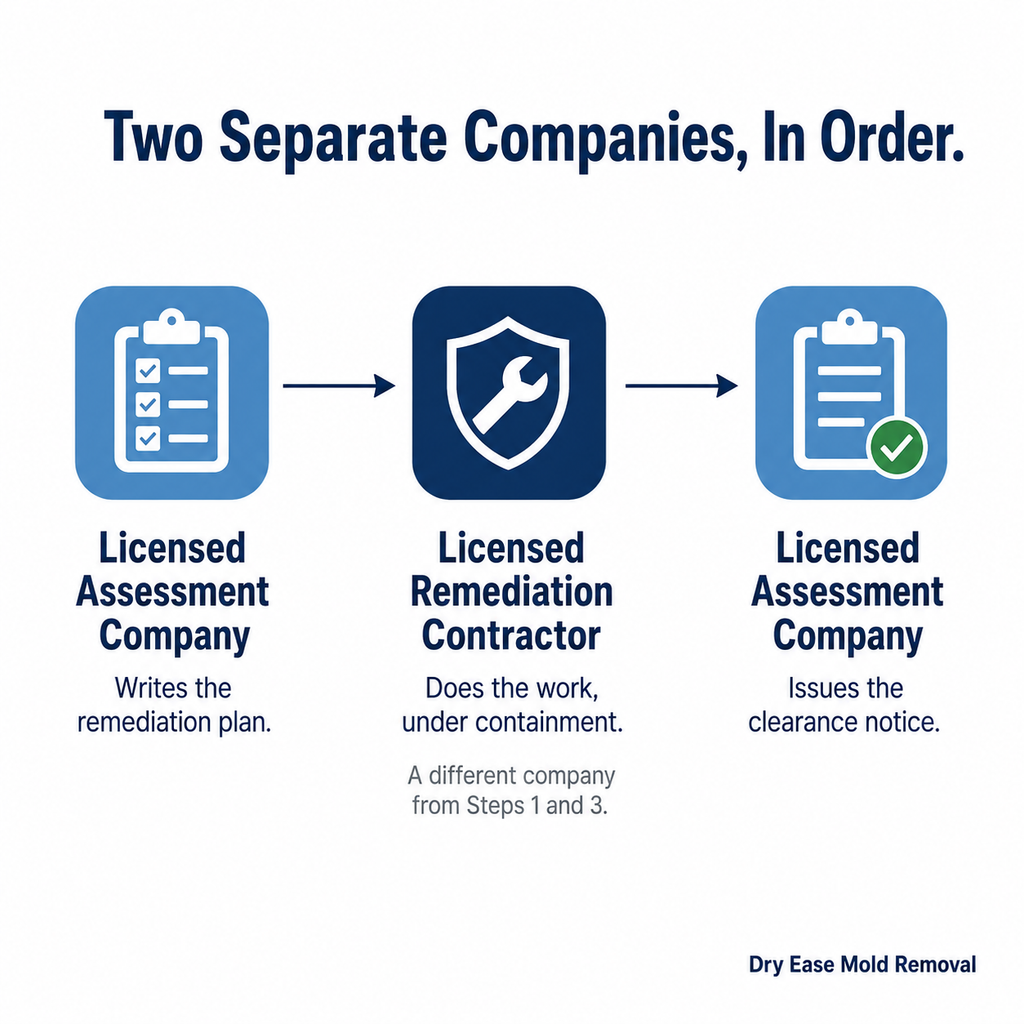
If a company is doing the work and the affected area is over 10 square feet, hiring the assessor is not optional. The plan and the clearance notice are both required, and only a licensed assessment company can produce either one.
You can hire an assessment company directly, or you can ask a remediation contractor for the names of independent assessors they have worked with. We hold the remediation license, so we do the removal and bring in an independent licensed assessor when a project requires one.
Who Is Exempt From New York’s Mold Licensing Requirement?
Article 32 lists four exemptions from the licensing requirement.
- A residential property owner performing the work on their own property. The statute does not put a unit count on this one. It says a residential property owner working on their own property, and it stops there. You will often see this exemption described as covering owner-occupied one and two family homes. That unit cap is not in Article 32. The four-unit limits people quote come from the separate landlord and employee exemptions below.
- A non-residential property owner, or an employee of that owner, performing the work on an apartment building the owner owns that has four or fewer dwelling units.
- An owner, a managing agent, or a full-time employee of either, performing the work on commercial property or on a residential building of more than four units the owner owns. This one carries a condition, and the statute writes it against the managing agent or the employee rather than the owner. The exemption does not apply if that agent or employee is in the business of performing mold assessment, remediation, or abatement for the public.
- Federal, state, and local government units and their employees, on property they own, manage, or remediate.
Being Exempt From the State License Is Not the Whole Answer in New York City
The state exemptions and the city rules answer two different questions. The state exemptions answer whether you need a license to do the work yourself. New York City’s indoor allergen rules answer what you owe a tenant once mold turns up, and they cover residential buildings with three or more apartments. Inspect, fix the moisture source, follow the safe work practices.
Those city rules do not set a licensing threshold of their own. On the question of who may do the work, they point back to Article 32 and to the city’s separate filing rule for larger buildings. So the size of the affected area still decides it, not the size of the building. Over 10 square feet and the job is a project. At 10 square feet or less it is not, in a three-unit building and in a 300-unit building alike.
Say you manage a 12-unit residential building in Brooklyn. The state does not require a managing agent to hold a license to work on a building the owner owns, as long as you are not in the business of performing mold work for the public. The 12 units do not change that. The measurement does. If the affected area is 10 square feet or less, no licensing rule is in play, though you still fix the moisture source and follow the city’s safe work practices. If it is larger than that, the job is a project, and a 12-unit building is a covered building under Local Law 61, so the notice before the work and the report after it both have to come from licensed companies. Nobody else can file them. On a job that size you hire a licensed assessment company and a separate licensed remediation contractor.
Outside New York City, the city rules do not apply, so an owner who fits one of the four categories can legally do the work without a license.
An exempt owner often hires a licensed contractor anyway. Opening a wall without containment can move a small problem into clean parts of the building. And if HPD has issued a violation, the remediation plan and the clearance notice from a licensed job are the documents that support your certification of correction.
Can Your Own Maintenance Staff Remove Mold?
Yes, in two situations. Two of the four exemptions are written for employees rather than owners. An employee of a non-residential owner can do the work in an apartment building of four units or fewer that the owner owns. A full-time employee of an owner or a managing agent can do the work on commercial property, or on a residential building of more than four units the owner owns.
The second of those two carries a condition. It does not apply if the managing agent or the employee is in the business of performing mold assessment, remediation, or abatement for the public. That condition runs to the agent and the employee, not to the owner. An in-house maintenance employee is fine under it. A management company that also sells mold remediation commercially cannot use this exemption on the buildings it manages.
Note the words “full-time” in that second exemption. An outside handyman you bring in is not covered by it and needs a license. And the exemption only answers who may do the work. It does not touch the city’s separate duties to inspect, to fix the moisture source, and to follow the safe work practices.
What Are the Penalties for Unlicensed Mold Work in New York?
The Commissioner of Labor can fine a violator up to $2,000 for an initial violation and up to $10,000 for each subsequent violation.
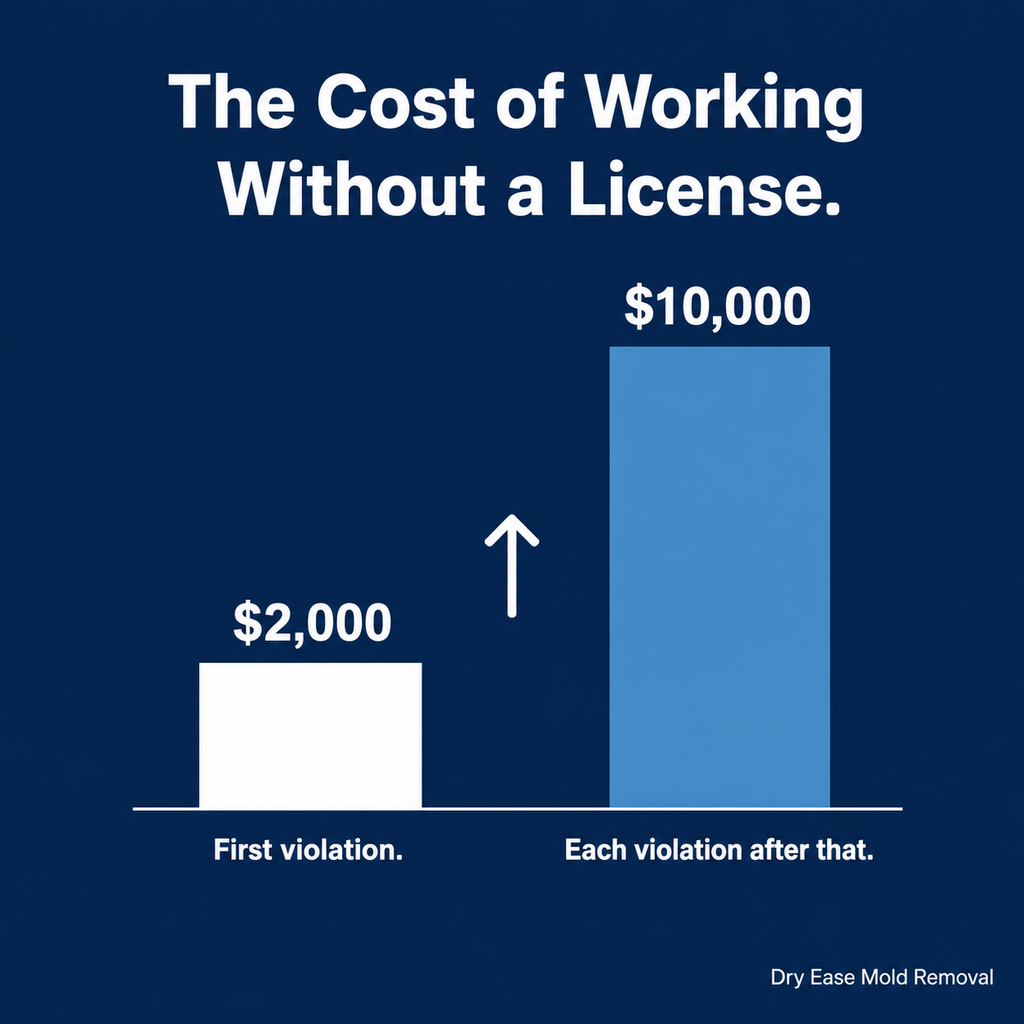
Those fines are aimed at whoever performed the unlicensed work. The bigger issue for the owner who hired them is that an unlicensed job does not produce the two documents you need. There is no remediation plan from a licensed assessment company, and there is no clearance notice at the end.
So if HPD wrote a violation on that unit, you have nothing to support a certification of correction. The violation stays open even though you paid for the work. In a building that has to file with the city, the filings come from licensed parties, and an unlicensed contractor cannot make them.
What Article 32 Does Not Require of Property Owners
Article 32 imposes no duty to inspect your property for mold, no duty to remediate mold you find, and no deadline for correcting anything. It governs who may perform the work and how the work has to be done once you decide to have it done.
An owner who believes the state requires annual mold inspections is preparing for a duty that does not exist. An owner who learns that Article 32 requires nothing of them can conclude that no mold rules apply at all, and that is wrong too. The duties sit in the city housing code and in landlord and tenant law.
Where a New York Landlord’s Mold Duties Come From
Two rules create most of what an owner owes a tenant about mold.
NYC Local Law 55: Yearly Inspections and Safe Work Practices
Local Law 55 applies to owners of multiple dwellings, meaning residential buildings with three or more apartments. It requires you to inspect every occupied unit and all common areas at least once a year. A building with one or two apartments is not a multiple dwelling, so Local Law 55 does not apply to it. The rule covers mold along with mice, rats, and roaches, which it groups together as indoor allergen hazards. It also requires you to inspect again whenever a tenant complaint or an HPD notice flags a possible problem.
When an inspection turns up mold, you have to fix the underlying moisture source and follow the safe work practices the rule sets out. Contain the work area, keep dust down, clean with detergent and water, bag and remove contaminated material, and leave the area dry and visibly free of mold and debris.
The rule also comes with paperwork. At every lease signing you give the tenant an indoor allergen notice and the health department pamphlet. And if HPD issues a mold violation on the building, the certification of correction you file has to include an affidavit affirming that the required work practices were properly performed.
The Warranty of Habitability in Every New York Lease
Every residential lease in New York carries an implied promise called the warranty of habitability. It says the unit is fit for people to live in. It also says a landlord cannot leave tenants living in conditions that are dangerous, hazardous, or detrimental to their life, health, or safety. A landlord cannot write it out of a lease.
The statute does not name mold. Courts routinely treat unresolved mold as a breach of that promise, particularly mold coming from a moisture problem the landlord has not addressed. A tenant can pursue a rent abatement or damages on that basis. The warranty applies everywhere in the state, inside the city and out.
The Filing Rule for Larger NYC Buildings (Local Law 61)
Local Law 61 is a notice and filing rule tied to licensed mold remediation work, and it applies to a narrow set of buildings. Administrative Code 24-154 applies only to what it calls a covered building. The code defines that as a building with 10 or more dwelling units. It also covers a building on a zoning lot with 25,000 or more square feet of non-residential floor area.
If your building is covered, the two filings come from the licensed companies you hire rather than from you. Your licensed remediation contractor notifies the city at least two business days before the work starts. If a court order requires the work finished within 30 days, or there is an immediate hazard, that notice can instead come within 24 hours after the work begins. Your licensed assessor then files the post-remediation assessment report no later than seven days after it is completed. The Department of Environmental Protection and HPD administer this section together. Your part is hiring licensed companies that can make those filings. Keeping your own copies of what they file is not a requirement of the code, but it is worth doing.
If you own a six-unit walk-up, none of that applies to you. There is no advance notice and no post-work filing. You are still covered by Article 32 for any job over 10 square feet, and still covered by Local Law 55 because the building has three or more apartments.
What to Do, in Order
Once you have looked at the unit and measured the affected area, this is the sequence for a job that needs licensed companies.
- Find the water and fix it. Look for the leak or the humidity problem that is feeding the growth. If it stays, the mold comes back no matter how well the removal was done.
- Hire the licensed mold assessment company first. They write the remediation plan, and the remediation contractor works from it.
- Hire a separate licensed remediation contractor. Containment goes up, signage goes at the entrances, and the affected materials come out according to the plan.
- Sort out occupants before work starts. The plan has to address how occupants get notified, and tenants and boards will ask whether people can stay in the apartment during remediation.
- Wait for the clearance notice. Containment does not come down until the assessment company issues it.
- Certify the correction with HPD. If HPD wrote a violation on the unit, this filing is what closes it, and the paperwork from the job is what backs it up.
- Keep the plan and the clearance notice. In a covered building, keep the post-remediation report your assessor filed as well. These documents show that the work met the state’s standards. HPD, an insurer, or a tenant’s attorney can all ask what was done, and without those documents you cannot answer.
How to Verify a New York Mold License
New York publishes the licenses as public data, so you can check a contractor before you sign anything. There are two lists: Mold Contractor Licenses for the companies, and Mold Individual Licenses for assessors, supervisors, and abatement workers. You can search by company name, by an individual’s name, or by license number.
Look at two things in the record. First, confirm that the license type matches the role. The company doing the removal needs a remediation contractor license, and the company writing the plan needs an assessment contractor license. Second, check the expiration date and the status, so you know the license is still active.
Checking a license tells you a company is allowed to do the work. It does not tell you whether the company does the work well. Our guide to finding a trustworthy mold remediation company in New York goes through what else to check.
Frequently Asked Questions
Does Article 32 apply outside New York City?
Yes. Article 32 is state law with no geographic carve-out, so the licensing rules work the same way in Buffalo as they do in Manhattan. Outside the city, the local rules do not apply. There is no Local Law 55 inspection duty and no Local Law 61 filing duty. The warranty of habitability applies everywhere in the state.
Do I need a mold license to remove mold in my own house?
No. A residential property owner performing mold work on their own property is exempt from the licensing requirement, and the statute puts no unit count on that exemption.
Can my tenants stay in the apartment during mold remediation?
Sometimes they can, and the remediation plan is where the answer comes from. The plan has to set out the containment and how occupants get notified, so the size and the location of the work area drive the decision for your unit.
Can one company do both the assessment and the removal if it holds both licenses?
No. The prohibition is written at the property level, so the same licensee cannot assess and remediate the same property even while holding both licenses.
Talk to a Licensed Mold Remediation Contractor
If you own or manage a New York property with a mold problem, you may not be sure which of these rules is creating your obligation. We are glad to walk through it with you. Dry Ease Mold Removal is a New York State licensed mold remediation contractor with over 20 years of experience in New York buildings. Our remediation work follows ANSI/IICRC S520, the industry standard for professional mold remediation. Article 32 sets its own minimum work standards and does not name S520 anywhere, so following it is something we hold ourselves to. We work across all five boroughs, Westchester, Nassau County, New Jersey, and Connecticut.
Call (877) 215-8399 or contact us, and we will come look at the affected area and scope the remediation work.