
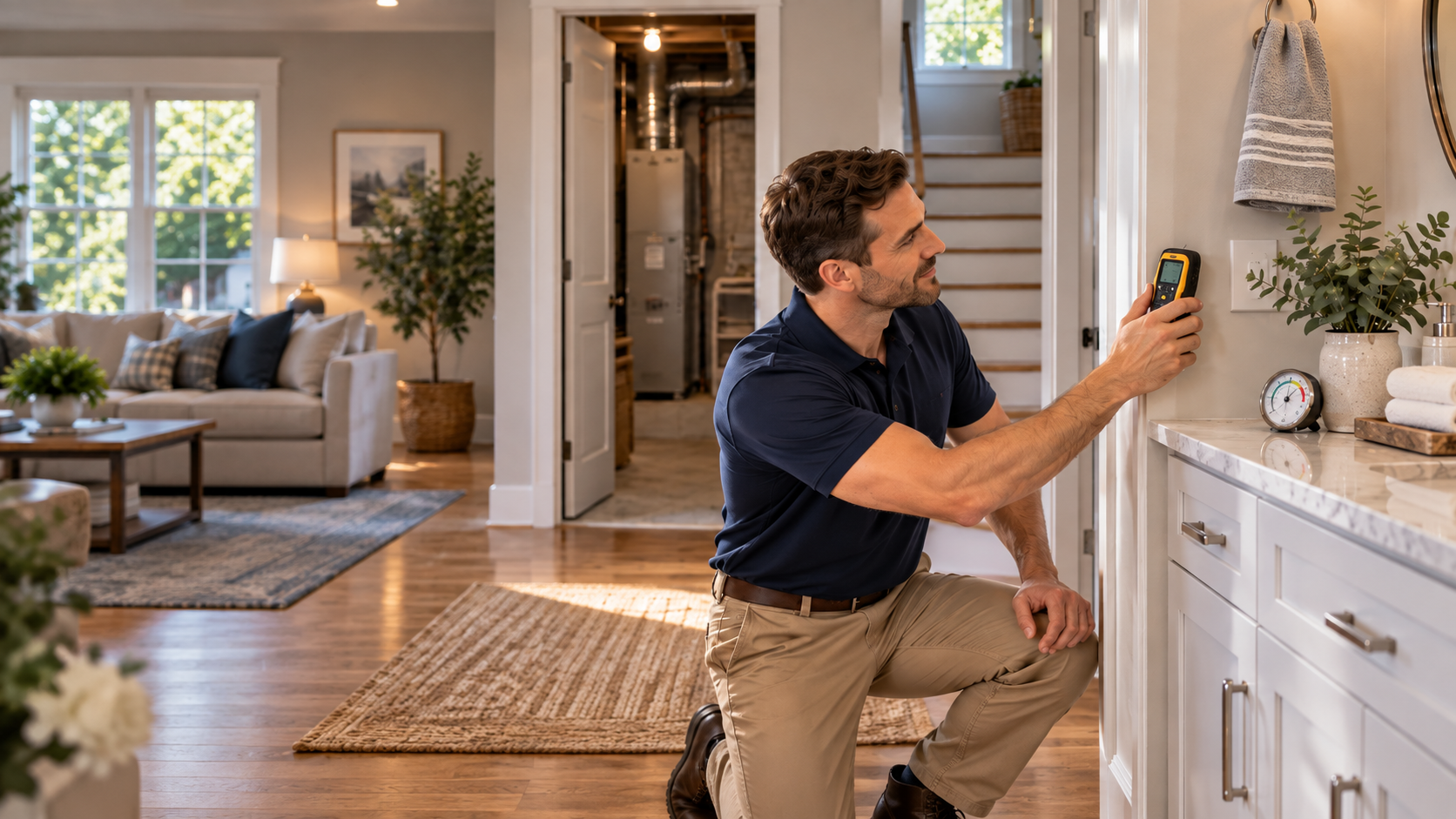
Short answer: The right humidity level to prevent mold is an average under 55 percent, with a normal, dry room reading around 40 percent. Mold growth takes a prolonged stretch above 55. In basements, attics and prewar risers, holding that number usually takes two or three fixes working together, and a single dehumidifier rarely does it.
On a normal day, a room with no water problem reads about 40 percent relative humidity on my meter. That holds in a wood-frame three-family in Ridgewood and in a masonry prewar in Manhattan. Most rooms I check swing between 40 and 60 percent with the season, the weather and the building.
The number I care about is the average. A room has to sit above 55 percent for a prolonged period before I expect mold, so one high reading after a shower tells you very little.
The standard advice is to buy a dehumidifier. Basements are the jobs we come back to most, and I’ve watched one dehumidifier fall short in them many times.
If your gauge keeps reading above 55 percent and you can’t find the reason, call 877-215-8399 for a free estimate. I’ll trace where the moisture is coming from before anyone talks about equipment.
What Humidity Readings Mean in a New York Home
The EPA’s guidance is to keep indoor humidity below 60 percent, and ideally between 30 and 50 percent, according to its Brief Guide to Mold, Moisture and Your Home (as of September 2026). My own line sits inside that range. When a room averages over 55 percent for a prolonged period, that’s where I start finding growth.
The highest readings I see are around 80 percent. Those come from flooded spaces, where trapped water is escaping into the air while the air outside is humid too. At that point the first job is drying the structure, and water damage restoration has its own timeline.
| Gauge reading | What it means | What to do |
|---|---|---|
| Around 40% | A normal, unaffected room, in a frame house or a prewar | No action. Keep checking the rooms that worry you. |
| 40% to 60% | The usual swing with season and weather | Track the average over time |
| 50% to 55% in a bathroom or kitchen | The top of where these rooms should sit | Open windows and doors, and run the exhaust fan when you cook or shower |
| Averaging above 55% for a prolonged period | The level where I start finding mold | Find the source: a riser, outside water or missing ventilation |
| Around 80% | A flooded space releasing moisture, often on a humid day | Treat it as water damage and dry the structure first |
Why a Frame House and a Prewar Get Humid in Different Ways
Wood-frame houses let the weather in
The three-family houses in Ridgewood are built with wood framing and OSB sheathing, with limited insulation. On a humid day, outside humidity works its way into the house, so the indoor readings follow the weather. In these homes, ventilation and insulation do as much work as any machine you plug in.
Prewar masonry sweats from the inside
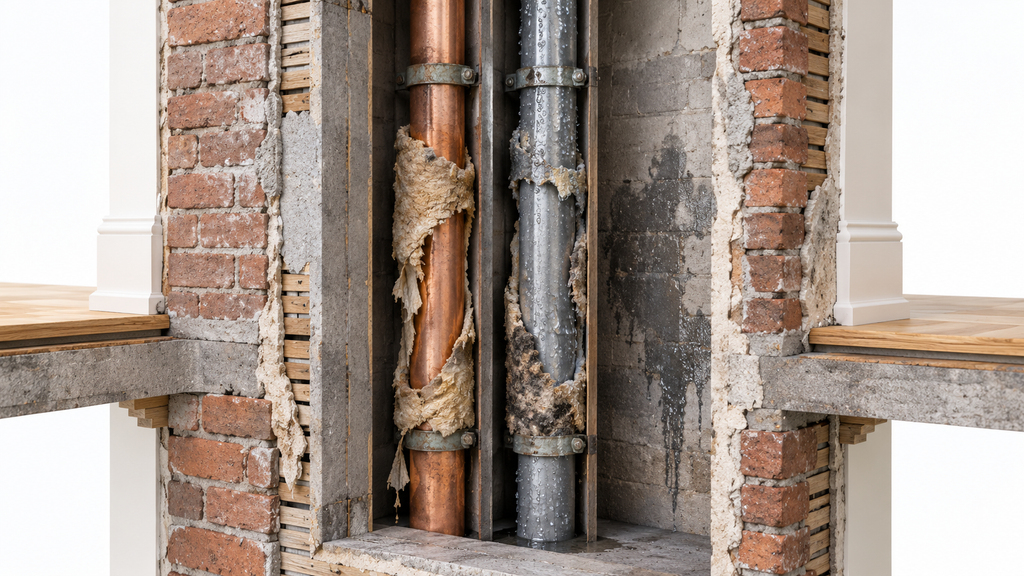
In Manhattan prewars and bigger masonry buildings, the humidity I chase usually comes from the plumbing. The risers are rarely insulated. Where they are, the insulation is so old it has deteriorated and carries no real R-value.
Hot and cold lines run through the same chase against the masonry, and those temperature differences make the pipes sweat. The outside of the riser wall sweats with them. Add a slight leak and the chase stays humid all the time, which is why the moisture shows up on bathroom and kitchen walls, right where the risers run.
| What to compare | Ridgewood wood-frame house | Manhattan prewar masonry |
|---|---|---|
| Built with | Wood framing and OSB, limited insulation | Masonry walls with pipe risers running through them |
| Where the moisture comes from | Humid outdoor air, plus rainwater at the foundation | Sweating risers and slight leaks inside the chase |
| Where it collects | Basements and attics | Bathroom and kitchen walls around the risers |
| What fixes it | Water diverted outside, ventilation, insulation and dehumidification, usually more than one | Reinsulating the pipes and repairing any leaks |
| Where to start | Gutters, grade and a gauge in the basement | A gauge by the riser wall, then a written note to the landlord |
Why One Dehumidifier Rarely Fixes a Basement
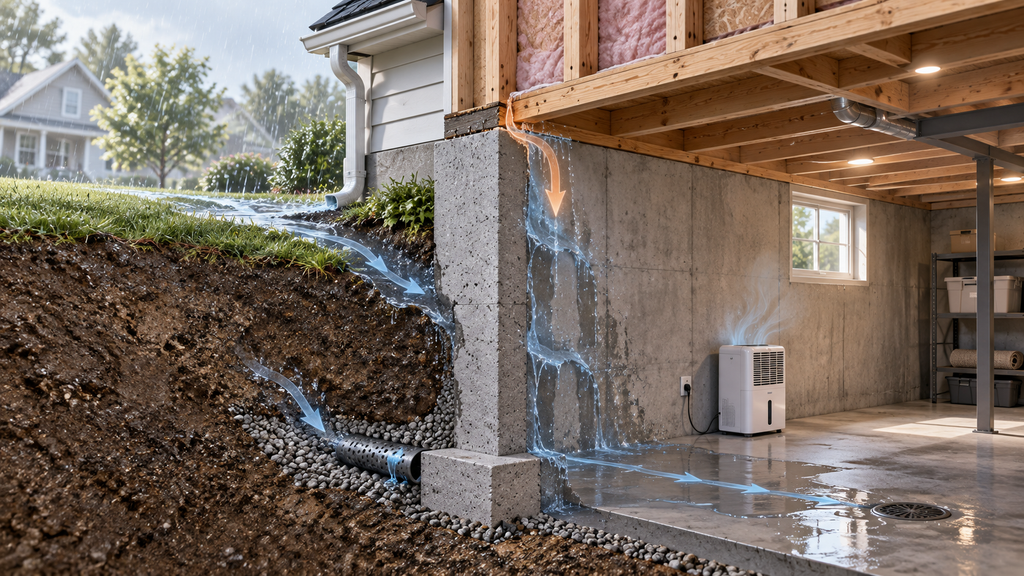
Basements are the jobs we come back to most, and the pattern repeats. It rains hard, there isn’t enough soil along the foundation to absorb the water, and it works its way in through the foundation wall and the sill. A dehumidifier pulls moisture out of the air. It can’t keep up with water coming through the walls every time it rains.
So the fix starts outside. Clean and repair the gutters, flash water away from the house, seal the foundation from the outside, and make sure the ground carries water away from the walls. Then dehumidify what’s left.
When a basement keeps reading high, one gauge in the middle of the room won’t tell you much. Put gauges in several spots. The readings show where the humidity concentrates, and those pressure points tell you where ventilation or dehumidification belongs. If you’ve already found growth down there, start with what to do after finding mold in your basement.
Why Attic Humidity Takes More Than One System
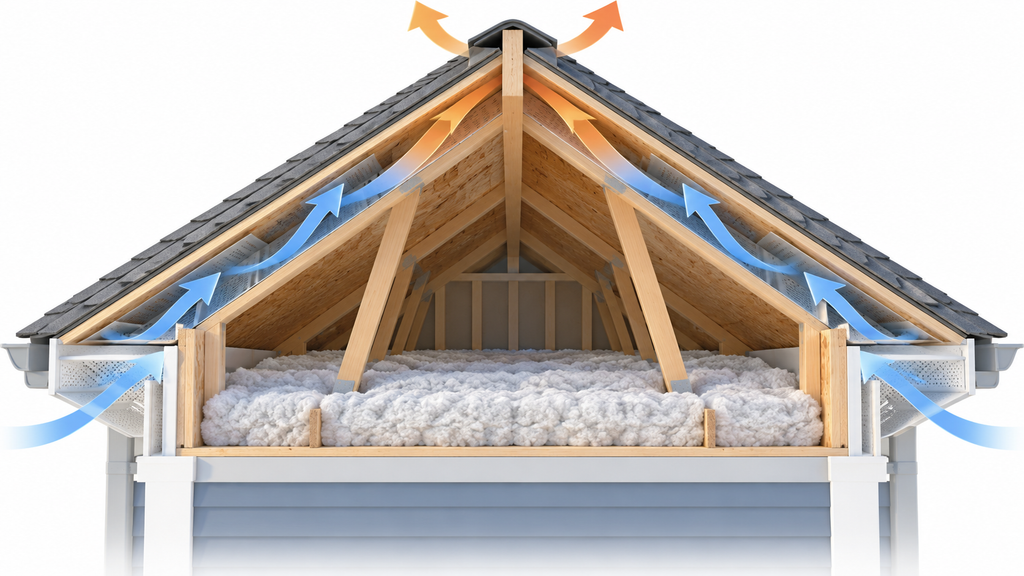
Attics are the hardest place I work to bring humidity down. It usually takes two or three things together: soffit vents to let air in low, baffles to keep the insulation from blocking that air, a ridge vent to let it out high, and sometimes an extraction fan or better insulation. The attics we finally got dry had several of these working at once.
What It Costs to Hold the Humidity Level to Prevent Mold
Do the cheapest thing first and work up. There’s no reason to pay for drainage before the gutters are clean.
The small things come first: cleaning and repairing gutters, flashing water away, sealing the foundation from the outside, opening attic windows or adding window vents. The middle tier is soil grade and vents. Drainage and retaining walls come last. You can do some of the soil work yourself, or have a landscaper build up the grade.
| Fix | Rough cost | What it handles |
|---|---|---|
| Humidity gauge | About $15 each | Shows which rooms average above 55% |
| Dehumidifier | About $300 | Moisture in the air of one space, once outside water is stopped |
| Attic or basement vents, static or humidity-controlled, with an electrician’s wiring | About $1,500 | Damp air that has nowhere to go |
| Regrading soil along the foundation | $3,000 to $5,000, depending on the corner or side of the house | Rainwater running toward the foundation |
| French drain | Around $10,000 | Groundwater the grade alone can’t carry away |
Keeping the Humidity Level to Prevent Mold in a Rental
Renters start by measuring. A humidity gauge costs about $15, so put a few around the apartment, especially in the bathroom and kitchen where the risers run. Those rooms should stay below 50 to 55 percent. Open windows and doors when you cook or shower, and use the exhaust fan or a regular fan to push the damp air out.
If the gauges stay high with all of that going, the source is probably inside the wall. The repair belongs to the building: reinsulate the pipes and fix any leaks, including slow ongoing ones. The EPA’s guide gives the same instruction about covering cold water pipes with insulation.
Under Local Law 55, owners of buildings with three or more apartments have to keep them free of mold, and that includes fixing the conditions that cause it (as of September 2026). Write your readings down with dates and send them to the landlord in writing. For landlords, leak detection finds a slow riser leak before a tenant’s gauge does.

Where I Disagree With Other Contractors: Plastic on the Inside
The advice I disagree with most is plastic. A lot of contractors put vapor barriers on the inside of the house, and that plastic ends up holding humidity in the wrong places. Moisture that gets into a wall has to dry somewhere. Plastic on the inside face gives it one less place to go.
I’d rather see the barrier work the way roofing shingles do, completely on the outside of the building, shedding water before it reaches the structure. Plenty of contractors will disagree with me on this. It’s the same principle as the gutters and the grade: stop the water outside and there’s less humidity to fight inside.
More Questions About Humidity and Mold
What is the right humidity level to prevent mold in a bathroom?
Keep a bathroom below 50 to 55 percent on a gauge. Run the exhaust fan and open the door or window when you shower. If the room stays above 55 percent with all of that going, look for a sweating or leaking riser inside the wall.
Is 60 percent humidity in a basement a problem?
One 60 percent reading falls inside the normal swing I see, but a basement that averages above 55 percent for a long stretch is where I expect mold. Track it over time. If it stays high, check the gutters, the grade and the foundation before buying more equipment.
Can I regrade the soil around my foundation myself?
Some of it, yes. You can build up the soil yourself or have a landscaper do it. A professional regrade has run my clients $3,000 to $5,000, depending on which corner or side of the house needs it.
Why is the wall next to my bathroom always damp?
In a prewar building, it’s often the riser behind it. Old pipe insulation loses its R-value, the hot and cold lines sweat against the masonry, and any slight leak adds to it. Tell your landlord in writing. The repair is reinsulating the pipes and fixing the leak.
Who You’re Getting This From
Dry Ease Mold Removal is a New York State licensed Mold Remediation Contractor (License 26-6AXK6-SHMO), serving New York City since 2003 with more than 10,000 completed jobs. Our technicians are IICRC certified in Applied Microbial Remediation and Water Damage Restoration.
Send a photo of your gauge and the wall beside it to support@dryeasemold.com, and I’ll tell you whether it’s worth a visit. For a free estimate anywhere in the five boroughs (Manhattan, Brooklyn, Queens, the Bronx and Staten Island), plus Westchester County, Nassau County, Rockland County and New Jersey, call 877-215-8399.