
Mold in your home really can make you sick. Indoor mold has been linked to coughing, wheezing and other upper respiratory symptoms, even in otherwise healthy people, and it can bring on asthma symptoms in people who already have asthma. It also irritates the eyes, skin, nose and throat, whether or not you have allergies. Those effects are established. A lot of what you’ll read online goes further than the evidence does.
At Dry Ease Mold Removal, we’ve helped more than 50,000 families, property managers and building owners across the New York area deal with mold, and the first question people ask us is usually about health: is my apartment doing this to me? It’s a fair question in this city. One in ten occupied homes in New York City reported mold in the past year, about 329,000 apartments and houses.
The most useful clue is that mold symptoms tend to track with the building. They often ease when you spend a few days somewhere else, and they come back when you return home. Doctors rely on exactly that kind of history to connect symptoms to a home, and you are the only person who can collect it.
What Does Mold Actually Do to Your Body?
Mold affects people in three established ways. It causes allergic reactions, the same kind pollen or a cat might: sneezing, a runny nose, red eyes, a skin rash. It irritates the eyes, skin, nose, throat and lungs, and irritation can happen even in people with no allergies at all. And in people who have asthma and are allergic to mold, it can set off asthma attacks.
One more finding surprises most people: the dampness itself is a problem. Damp indoor spaces are linked to asthma attacks and other respiratory problems even when no mold is visible. So a musty smell and a wall that stays damp deserve attention even if you never find a dark patch.
What Are the Symptoms of Mold Exposure?
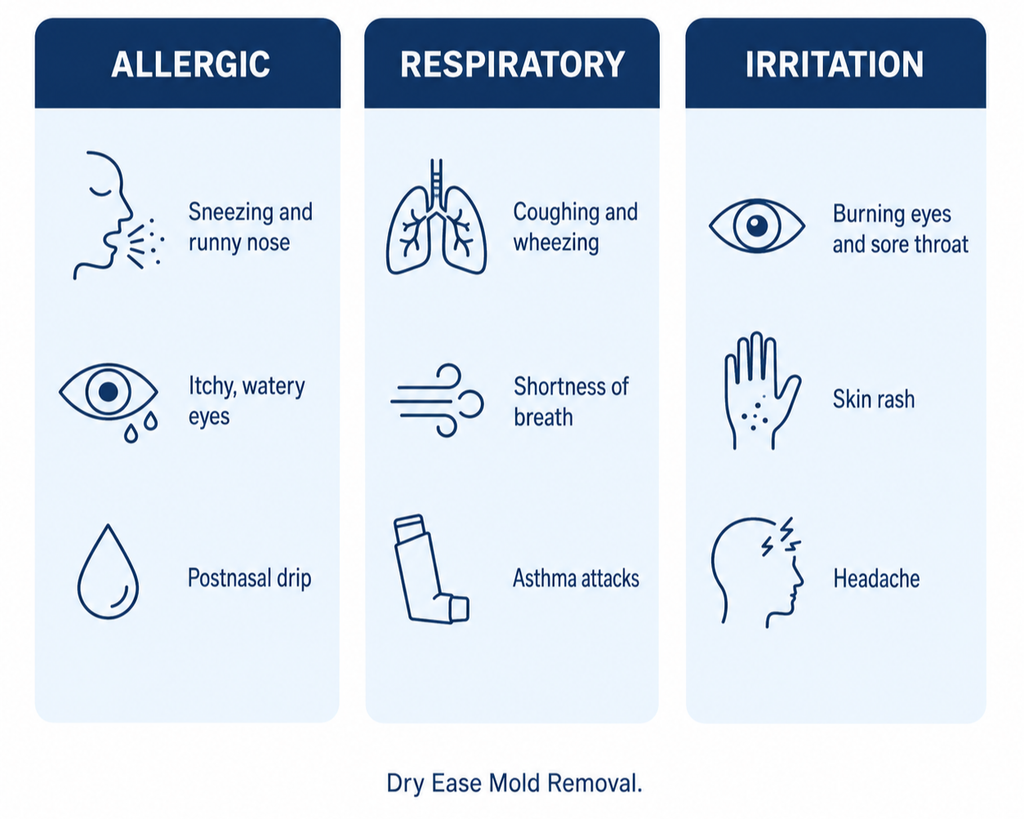
The symptom lists that health agencies publish overlap heavily, and the symptoms every agency agrees on are the ones you can trust. Here is the combined picture from New York State’s official guidance and the federal lists, grouped by type so you can find yours.
Allergic symptoms
- Sneezing and a runny nose
- Nasal and sinus congestion
- Itchy, red or watery eyes
- Itchy nose, mouth or throat
- Postnasal drip
Respiratory symptoms
- Coughing
- Wheezing
- Shortness of breath or difficulty breathing
- Chest tightness
- Asthma attacks, in people who have asthma
Irritation symptoms (no allergy required)
- Burning eyes
- Sore or irritated throat
- Skin rash or itchy skin
- Headache
None of these symptoms is unique to mold. A cold, seasonal allergies or dust can produce most of the same list, so the best clue to the cause is when and where your symptoms happen, not the symptoms themselves.
Can Mold Cause Brain Fog, Fatigue or Memory Problems?
If you search your symptoms, you will find pages saying mold causes brain fog, memory loss, mood changes, chronic fatigue, ringing in the ears and sensitivity to light. Many of those pages also sell a test or a treatment for “mold toxicity.” Here is where the evidence actually stands.
The major allergy organizations have reviewed these reports. Their conclusion so far: the evidence is insufficient to show that inhaling mold toxins in a home causes that cluster of symptoms. Federal guidance says the same thing: symptoms beyond the allergic and irritant types are not commonly reported from inhaling mold.
At the same time, two symptoms from that cluster do appear on official lists in a limited way. Fatigue and headache show up as allergy symptoms that develop later, after the congestion sets in, rather than right away. And difficulty concentrating is a recognized complaint in buildings with indoor air problems generally, even though no specific cause has been identified for it.
So the honest answer has two parts. Your symptoms can be completely real, and people with these complaints are often genuinely unwell. The “mold toxicity” explanation for them, though, has not been established.
Ringing in the ears and sensitivity to light deserve their own note: neither appears on any health authority’s list of mold effects at all. A page that calls them classic mold symptoms has gone beyond the evidence.
One more point, and this one argues against blaming the apartment. If fatigue or brain fog is your only symptom, with no congestion, cough, or eye, skin and throat trouble, mold is an unlikely explanation on the current evidence. Work with your doctor on other causes rather than assuming the apartment did it.
Is It Mold, a Cold, or Seasonal Allergies?
Most of the symptoms above could just as easily be a lingering cold or seasonal allergies. These are the differences that actually help:
| Mold | A cold | Seasonal allergies | |
|---|---|---|---|
| How long it lasts | As long as the exposure continues. Indoor mold can cause symptoms in any month, and they usually fade once the mold is removed | Usually 3 to 10 days, though a cough can last a couple of weeks longer | Several weeks at a time, for as long as the pollen you react to is in the air |
| Fever | No for typical allergic reactions. Fever with shortness of breath after heavy exposure is a reason to see a doctor | Sometimes, usually low-grade | No |
| Itchy, watery eyes | Common | Rare | Common |
| What happens when you leave the building | Symptoms typically ease within a short time away from the building and return when you are back | No change. A cold runs its course wherever you spend your time | Little connection to any one building. Symptoms follow pollen outdoors, and staying indoors with windows closed usually helps |
| Time of year | Any season. Indoor mold does not follow the pollen calendar, and damp weather can make symptoms worse | Any season | Follows the pollen calendar: trees in spring, grasses in late spring and summer, ragweed from late summer to the first frost |
Do Your Symptoms Improve When You Leave Home?
Mold symptoms track with the building: away from the exposure they tend to ease, and back home they return. Official guidance describes the same pattern. People with building-related symptoms usually report relief soon after leaving the building, and doctors are advised to look for symptoms that improve on weekends and vacations.
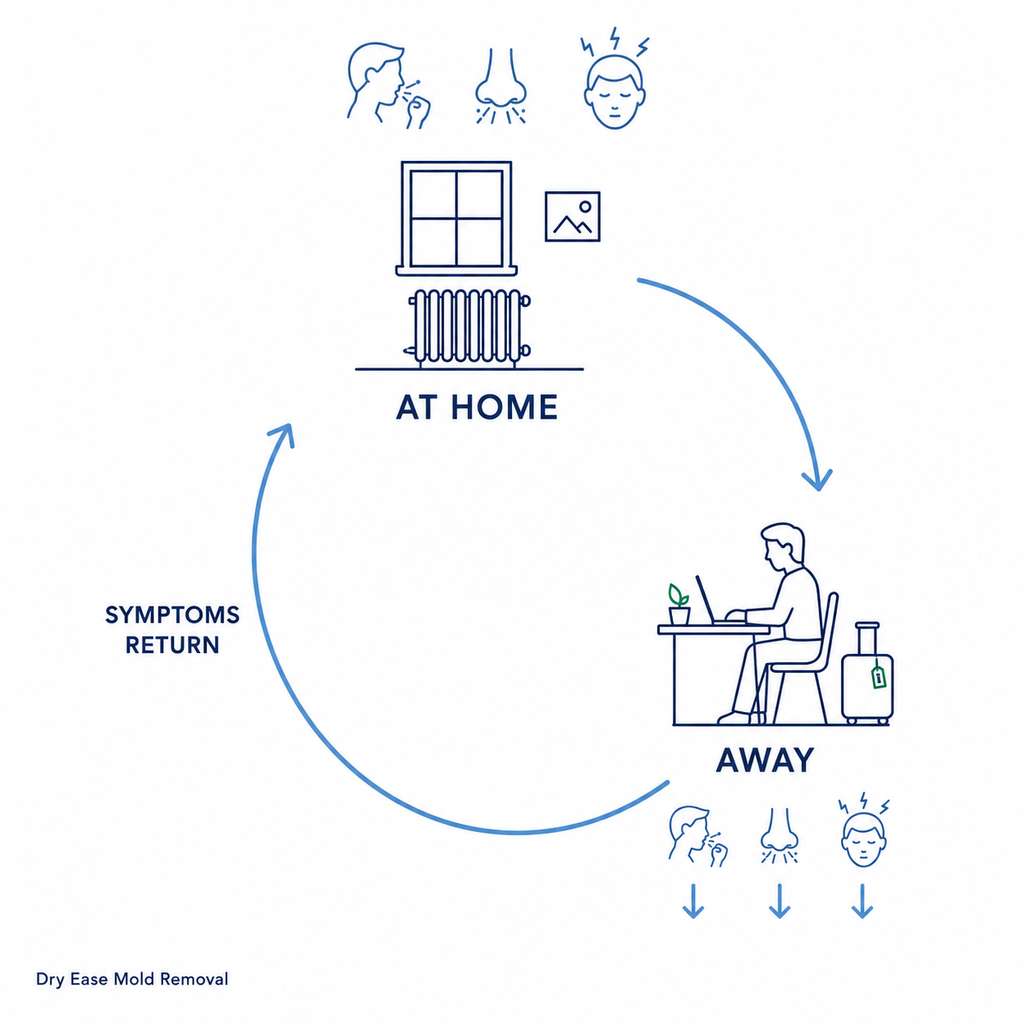
Doctors take that pattern seriously. An allergy test can show that your immune system recognizes mold. It cannot show that the mold in your apartment is causing your symptoms. The specialists’ own guidance says your history is what makes that link: when symptoms happen, where they happen, and when they stop.
You can collect that history deliberately:
- For two weeks, write a short daily note. Rate your congestion, cough and headache in the morning and evening, and note where you slept.
- Pay attention to full days away from home, at work or on a weekend trip. Note whether symptoms eased, and how quickly they returned once you were home.
- If you can sleep somewhere else for a few nights, do it and keep taking notes. That is the clearest version of this test.
- Photograph any visible mold or water stains, with dates.
If your symptoms are at their worst when you wake up, pay attention to the room where you sleep. You spend more unbroken hours there than anywhere else in the apartment, and in radiator-heated buildings the cold exterior wall behind a bed or inside a bedroom closet is a common condensation spot.
Bring the notes to your doctor. They supply the information that allergy testing cannot.
How Soon Do Mold Symptoms Start, and How Long Do They Last?
You would expect a number here: so many hours from exposure to symptoms, so many days to recover. No health authority publishes either number. When a website gives you exact figures for this, those figures did not come from health guidance.
Here is what the guidance does say. Allergic reactions to mold can begin right away, and in some cases they are delayed. Symptoms also arrive in phases: itching, sneezing and watery eyes tend to come quickly after contact, while congestion, cough, fatigue and headache tend to develop later. So you can feel only mildly unwell at first and worse over time while the exposure continues.
Recovery is described the same way: the sources agree on what happens, but none of them gives a number. Symptoms usually fade after the mold has been removed, and people often feel relief within a short time of leaving a moldy environment. If your symptoms continue after the mold and the moisture behind it are gone, tell your doctor.
Who Is Most at Risk From Mold?
Mold is harder on some people than others. Take symptoms more seriously, and act sooner, if any of these describes you or someone in your home:
- People with asthma or a mold allergy, who can have stronger reactions
- People with weakened immune systems, such as organ transplant or chemotherapy patients, who can develop lung infections from mold
- People with chronic lung disease
- Children and older adults
For parents, the asthma question deserves a careful answer. The evidence is settled that damp, moldy housing makes existing asthma worse, in children and adults. Some research also suggests that early mold exposure may play a role in some children developing asthma in the first place, particularly children already prone to it. That second link is suggested, not settled.
One thing we will not promise is that fixing the mold will fix a child’s asthma. In homes repaired to remove mold, adults’ asthma symptoms improved, but the research has not shown a clear improvement in children’s asthma symptoms after repairs. Removing a child’s exposure to mold is still worth doing. Just keep treating the asthma with your pediatrician while you deal with the building.
Is Black Mold More Dangerous Than Other Mold?
No. This surprises people, but health authorities treat all indoor molds the same when it comes to health risk and removal. No test proves that any particular species caused a person’s symptoms, and identifying the species does not change what you do about it.
The “toxic black mold” reputation dates to the 1990s, when a cluster of infant illnesses was blamed on one dark-colored mold. Later review found the link was never proven.
Color tells you nothing about risk. A black patch is not automatically dangerous, and a white or green one is not automatically safe. If mold is growing in your home, the species does not change the plan: find the moisture, remove the growth.
Can a Doctor Test You for Mold Exposure?
There are medical tests involving mold, but no test can prove that mold exposure caused your illness. Knowing what each test actually shows will save you money and confusion.
An allergist can run a skin prick test or a blood test for mold allergy. A positive result shows sensitization, meaning your immune system recognizes mold. It does not show that mold is causing your current symptoms, and it cannot point at your apartment. That is why the location notes matter so much: a test result plus your history is what lets a doctor connect your symptoms to a cause.
You will also find blood and urine “mycotoxin panels” sold for mold illness or mold toxicity. Allergy specialists warn that these panels are not standardized, can produce false positives and false negatives, and have no established threshold for what a harmful level would even be. Before you spend the money, know that no one can tell you what the result means for your health.
Should You Test Your Home for Mold?
If you can already see mold or smell a musty odor, testing the home usually adds nothing. Mold testing is not recommended by any health or regulatory agency, and there is no state or federal standard for how much indoor mold is acceptable, so a lab report has nothing official to compare against. Money spent on sampling is usually better spent fixing the problem.
Two things to keep in mind, though. First, that advice is about the testing you would order to answer your own question: is this really mold, and how much is there? Larger New York remediation projects can still require a formal assessment as a compliance step, performed by an independent licensed assessor. Second, seeing no mold does not mean there is no mold. Dampness alone is linked to symptoms, and mold often grows inside wall cavities where you will never see it. A musty smell that will not go away is a reason to go looking for the moisture source.
When Should You See a Doctor About Mold Symptoms?
See a doctor when symptoms have lasted more than a couple of weeks, keep returning, or interfere with sleep, work or breathing. You do not need to be sure it is mold first. Bring your location notes. They give the doctor the timeline that testing cannot supply.
- Make an appointment if congestion, cough, headaches or eye irritation have gone on for weeks, especially if they follow the home-and-away pattern.
- If you have asthma and it is getting harder to control at home, see your doctor promptly.
- If your immune system is weakened or you have chronic lung disease, treat new symptoms in a moldy home as reason for a prompt visit, since serious lung infections are possible in these groups.
- Go to urgent care for fever with shortness of breath, or for any severe trouble breathing. Heavy exposure can, in rare cases, cause a more serious immune reaction in the lungs, with fever, chills and extreme fatigue.
One more rule: if you have health concerns, talk to a clinician before you clean up mold yourself. Cleaning disturbs the mold, and that is a bad job for the person who is already reacting to it.
Why Do NYC Apartments Grow Mold in the First Place?
Mold needs moisture, and it does not need much time. Wet building materials can start growing mold within 24 to 48 hours. In New York housing, the moisture usually comes from the building itself. These are the sources we find over and over:
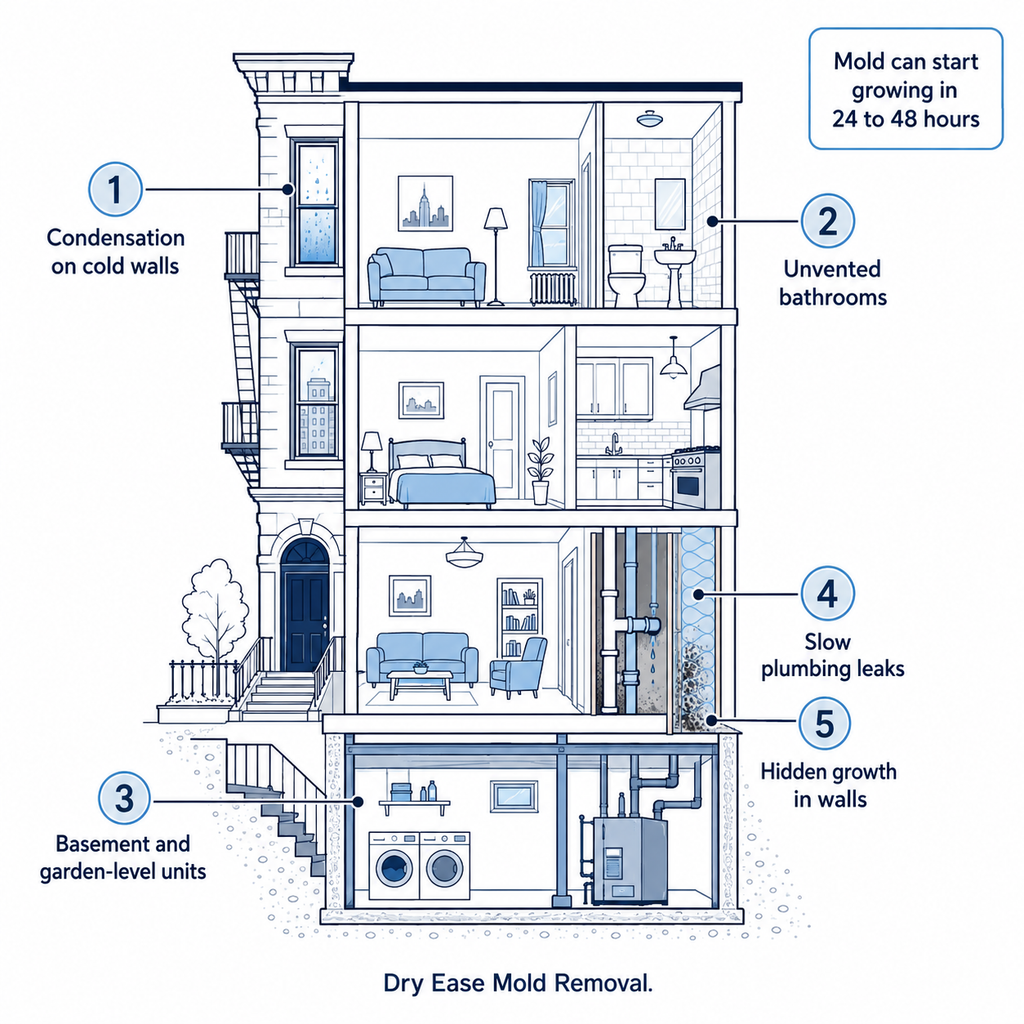
- Condensation on cold exterior walls. In radiator-heated pre-war buildings, warm humid indoor air meets cold brick in winter, and water condenses on the inside of exterior walls, often behind furniture or inside closets.
- Bathrooms without windows. Many vent into shared risers the tenant does not control, and some barely vent at all, so shower moisture soaks into walls and ceilings.
- Garden-level and basement apartments. Below-grade walls take on ground moisture, and these units get the least air and light in the building.
- Slow leaks in aging plumbing. Supply lines, roof leaks and old plumbing stacks can drip inside walls for months before anyone notices. Leaks are the most common housing problem in the city: one in five NYC homes reported one.
- Growth inside wall cavities. Mold does not need light. It can spread inside a wall for a long time, and a musty smell is often the only sign.
This is why the standard advice to “run your exhaust fan and buy a dehumidifier” often fails in these buildings. A dehumidifier cannot stop a leak from the apartment above, a fan cannot fix a bathroom with no duct to the outside, and no appliance changes what is happening inside a wall. In our remediation work at Dry Ease, one of the most common repeat calls we get is mold that came back weeks after someone scrubbed it away, because the moisture source was never found. Finding that source, sometimes with professional leak detection, is the first step.
What to Do If You Own Your Home
Start with the moisture source, whatever you decide about the mold itself. If you clean the growth without fixing the water, the mold comes back.
For a small area, federal guidance says most people can do the cleaning themselves if the patch is under about 10 square feet, roughly 3 feet by 3 feet. Use detergent and water on hard surfaces and dry the area completely. Moldy porous materials, like carpet or ceiling tile, usually need to be replaced rather than cleaned.
Bring in professional help when any of these is true:
- The growth covers more than about 10 square feet, or there has been a lot of water damage.
- You suspect mold in your heating and cooling system. Do not run it until it has been checked.
- The water involved was sewage or otherwise contaminated.
- You have health concerns. Talk to your doctor before doing any of the work yourself.
If you own a co-op or condo, the moisture source may sit in a shared wall, a neighbor’s unit or the building’s systems, so bring your managing agent in early. And before you book anyone, it helps to know what professional mold removal actually involves, so you can judge who is doing it properly.
What to Do About Mold If You Rent in NYC
If your building has three or more apartments, or if someone with asthma lives in your home, your landlord is legally required to keep your home free of mold. That duty comes from Local Law 55 of 2018, which also requires owners to inspect every occupied apartment for mold and other indoor allergen hazards at least once a year. The part that matters most is this: the owner must investigate and correct the underlying defect, the leak or moisture condition, and not just the visible patch. A landlord who paints over mold without fixing the water has not met the obligation.
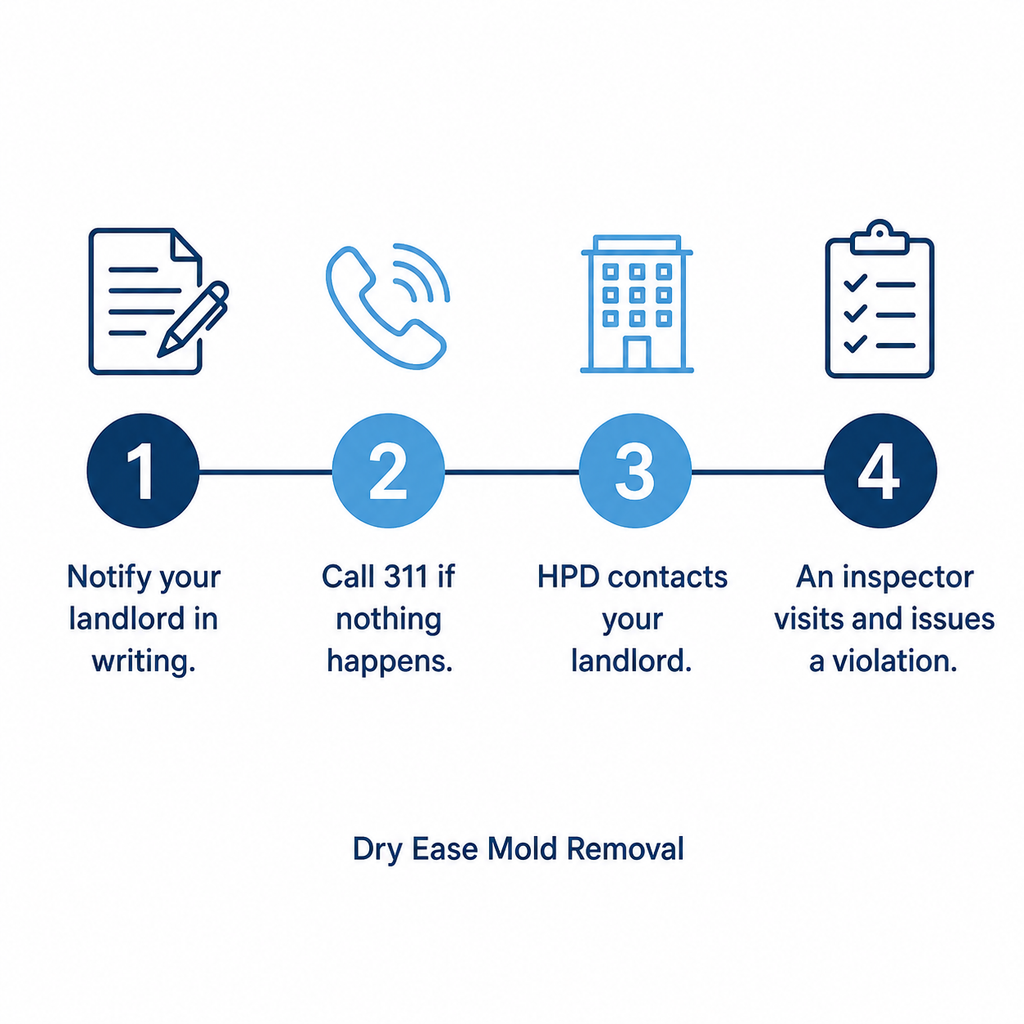
Here is the path:
- Tell your landlord or managing agent in writing. Date it, keep a copy, and photograph what you can see: the mold, or any water stains and damp spots, with something in the frame for scale. The city itself says to start with the owner, and the written record protects you if the landlord does not act.
- If nothing happens, file with 311. Call 311, use the app, or file online. You will get a service request number. Save it.
- HPD follows up. The city’s housing agency contacts your building’s managing agent, then checks back with you. If the mold is still there, an HPD inspector visits, and the owner gets no advance notice of the date.
- If the inspector finds mold, the violation depends on the size. So does the deadline:
| Mold found in your apartment | Violation class | Landlord’s deadline to fix it |
|---|---|---|
| Under 10 square feet | Class A (non-hazardous) | 90 days |
| 10 to 29 square feet | Class B (hazardous) | 30 days |
| 30 square feet or more | Class C (immediately hazardous) | 21 days |
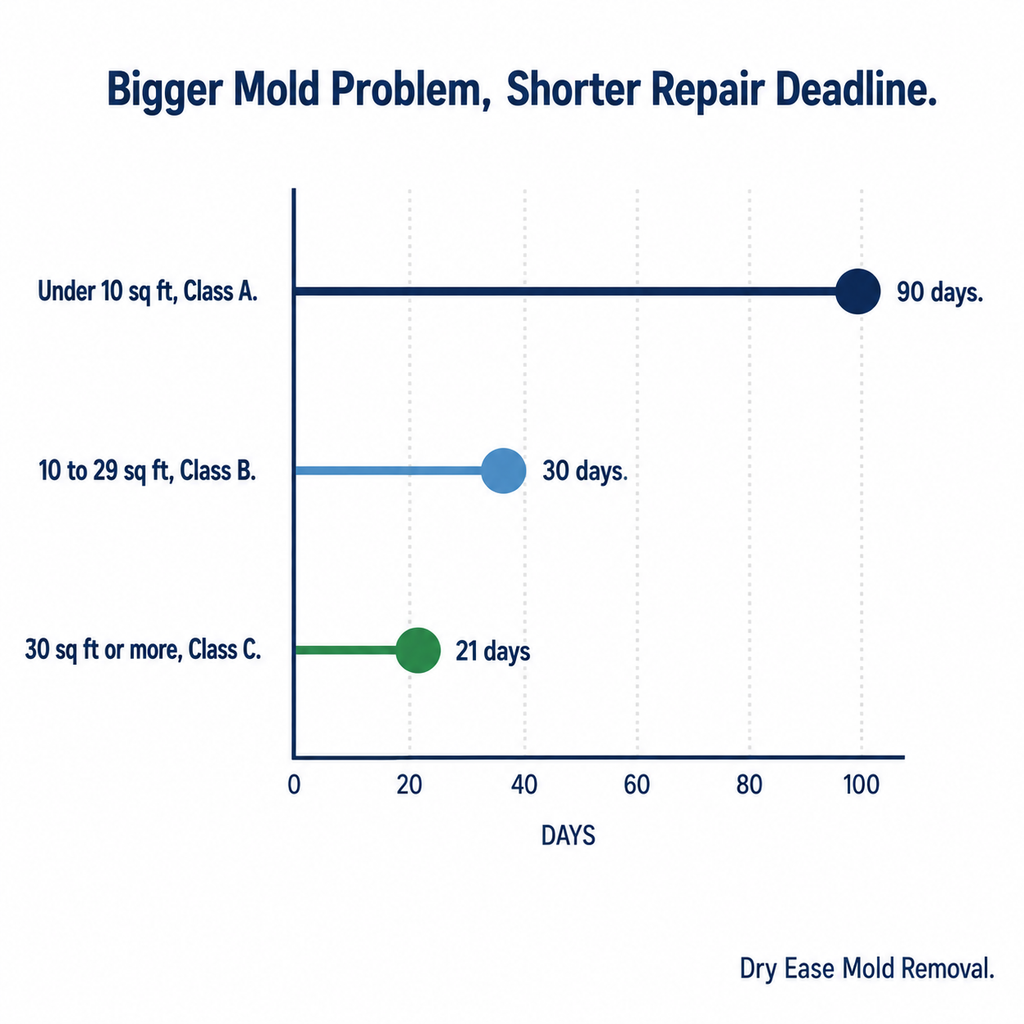
Deadlines are counted from the date HPD serves the violation, not from the day you called 311.
Notice two things about that table. Even mold classed as immediately hazardous comes with a 21-day deadline. And a patch under 10 square feet, which is what most renters are dealing with, is only a Class A violation with a 90-day deadline.
So for a small patch, your written notice and dated photos will usually do more for you than waiting on the city. If the same patch keeps returning after a wipe-down, document each return, because a patch that comes back points to an underlying moisture problem the law requires the owner to correct.
If deadlines pass and nothing changes, you can start an HP proceeding in Housing Court, where a judge can order the landlord to make the repairs. The written record you built is exactly the evidence that case needs.
What if all you have is the smell and nothing to photograph? Report it anyway, the same way: the smell, any water stains or damp spots, and your symptom notes, in writing. The law treats a tenant’s maintenance request as a trigger: once you report the condition, investigating the moisture problem becomes the owner’s job.
Mold does not have to be visible to be worth reporting. The duty covers moisture conditions that may cause mold, and a hidden source is exactly what an investigation is for.
Can you clean a small patch yourself before anyone comes? Yes. Federal guidance says most people can clean a patch under about 10 square feet themselves, and nothing in that guidance changes based on whether you rent or own.
Do two things first, though. Photograph the patch and send your written notice before you clean, because a wiped wall leaves nothing to inspect. And if you already have symptoms, ask your doctor before doing the cleaning yourself, or leave it to the landlord to handle.
Cleaning the patch also does not end the landlord’s duty. The moisture behind it is still legally theirs to fix, so keep your written record going even after the wall looks clean.
Is It Safe to Stay in Your Apartment While You Wait?
Nobody can tell you from a distance whether your apartment is safe. There is also no official threshold that could settle the question: there are no federal limits set for mold in homes. The evidence does give you a way to decide, though. For most otherwise healthy adults, the established effects of mold are the allergic and irritant kind, and symptoms usually ease within a short time of getting away from the exposure. That makes waiting out a repair mostly a question of how bad your symptoms are.
Go by your symptoms. If they are mild and steady, documenting the problem and pushing the repair forward is a reasonable plan, and nights spent somewhere else help in two ways: you get relief, and you add to your location record. If anyone in your home is in a higher-risk group, ask your doctor directly whether you should stay, rather than waiting out the deadline. That means anyone with asthma, a weakened immune system or chronic lung disease, and young children and older adults. And if you have fever with shortness of breath, or asthma that is getting harder to control, get medical care promptly no matter where the landlord’s deadline stands.
When Does New York Require a Licensed Mold Professional?
New York’s licensing rule is about who you hire. If you hire a contractor for a mold job larger than 10 square feet, New York State requires that contractor to hold a state mold license. The law also splits the work in two: the company that performs the mold assessment cannot be the company that performs the remediation on the same property. The state requires two separate licensed businesses so that the company measuring the problem does not profit from the size of the removal job. That 10-square-foot line is a hiring threshold, and it is a different rule from the federal cleaning guidance, which happens to use the same number.
The rule does not force you to hire anyone. It binds the contractors you do hire. Property owners doing mold work on their own homes are exempt, and for small conditions the city’s own work rules call for ordinary cleaning with soap and water. In larger buildings, meaning those with 10 or more units, building staff cannot legally handle a mold job over 10 square feet. The owner must hire outside licensed contractors, and those contractors also file plans with the city before the work and results after it. That filing requirement is paperwork for the contractors. It is separate from your landlord’s duty to fix mold, which comes from Local Law 55.
If you do hire, the license is your first screening question, and there is more to check after that. We wrote a guide to finding a trustworthy mold remediation company in New York that covers the rest.
More Questions About Mold in NYC Homes
Can mold symptoms be seasonal like pollen allergies?
They can be, when the mold is outdoors: allergy symptoms from outdoor mold are most common from July until the first hard frost. Indoor mold can cause symptoms in any month. If your symptoms track with your apartment rather than with the season, that points to an indoor source.
Does indoor humidity affect mold symptoms?
Yes. Indoor humidity above 50 percent is a listed risk factor for mold allergy symptoms, along with poor ventilation and moisture from leaks or flooding.
Should you use bleach to clean mold?
You do not need it: detergent and water works on hard surfaces. If you do use bleach, keep it to no more than 1 cup per gallon of water, and never mix bleach with ammonia.
What happens if the landlord misses the HPD deadline?
A hazardous-class mold violation that is not corrected, or that the owner falsely certifies as corrected, upgrades to the immediately hazardous class when HPD reinspects. Civil penalties apply on top of that, and you can still take the landlord to Housing Court.
Do you have to move out during mold remediation?
Often no. It depends on the size and location of the affected area and how well the work area can be contained. We cover the details in our guide to staying in your apartment during mold remediation.
If It Does Turn Out to Be Mold
Your doctor can take the health questions from here. The building questions are the ones we can help with. Call Dry Ease Mold Removal at (877) 215-8399 for a free assessment. We will inspect the affected area and the moisture behind it, and tell you plainly what you are dealing with, including when it is not mold at all, because not every dark spot is mold.
We’re a family-owned company. Our owner, Rob Gershman, has over 20 years of experience in New York mold remediation and still personally oversees complex projects. Our work follows the ANSI/IICRC S520 standard, and we hold a New York State mold remediation license. When a project requires a formal assessment, we bring in an independent licensed assessor, exactly as the law requires. We work in all five boroughs, including Brooklyn and Manhattan, as well as Westchester County, Nassau County, New Jersey and Connecticut.