
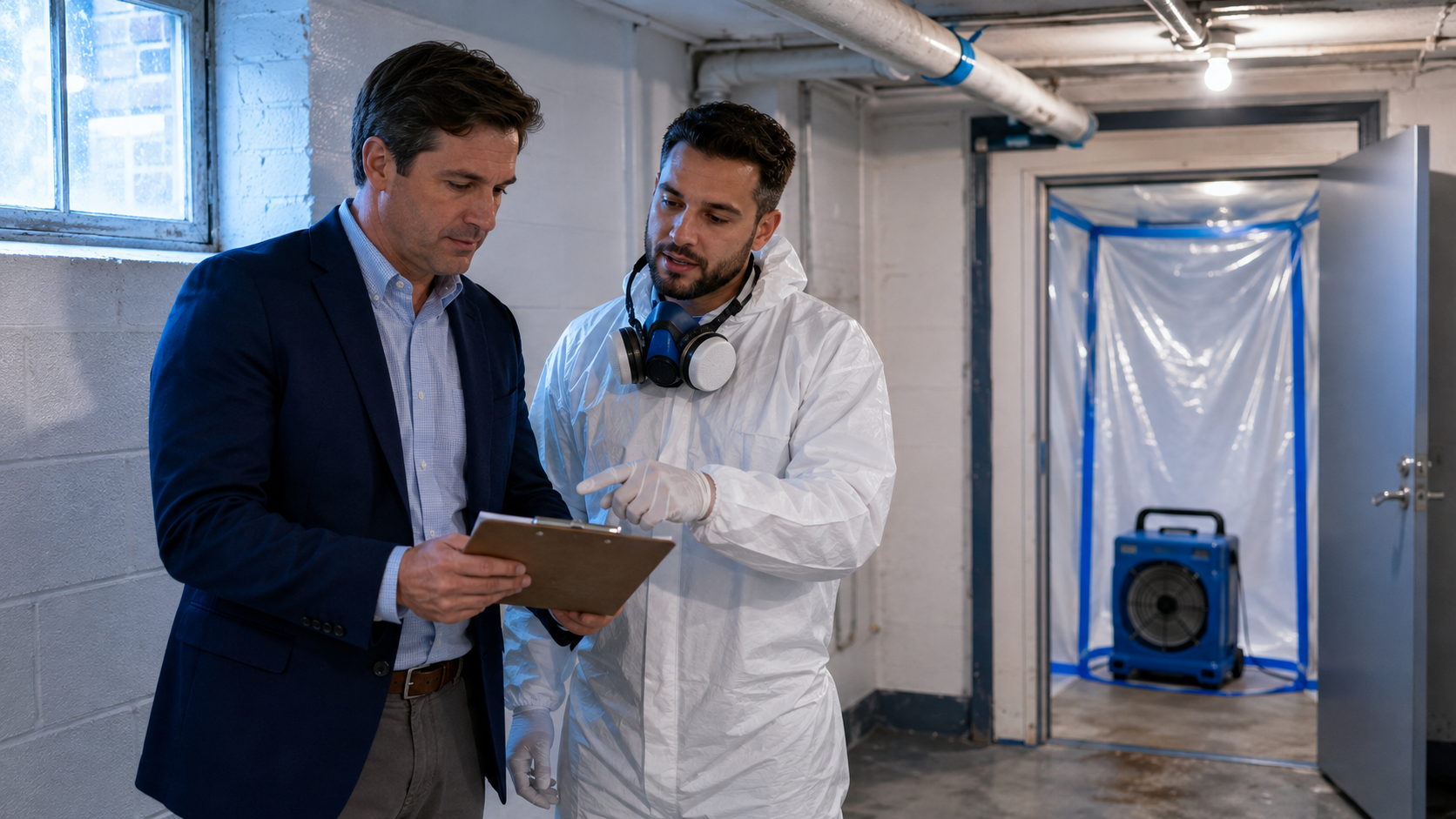
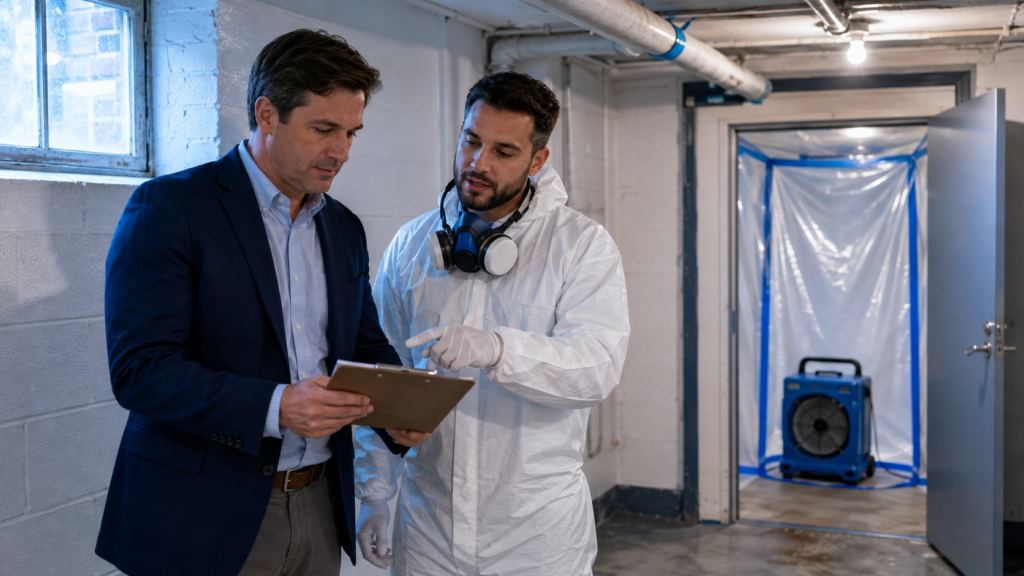
In New York, if you are hiring an outside company to remove mold from an area larger than ten square feet, that company has to hold a state mold remediation contractor license, which the New York State Department of Labor issues and enforces. You do not have to rely on what a contractor tells you about that license. The state publishes its mold license records publicly, and you can check any company yourself in a few minutes for free.
At Dry Ease Mold Removal, we hold the New York State mold remediation contractor license, and we work through HPD violations and insurance documentation for property managers and building owners regularly. The checks below are the ones we would want a property manager to run on us.
Before you sign anything, check these five things:
- Confirm the license type matches the work you are hiring for, and that the license is active.
- Confirm the company doing the testing is not the company doing the removal.
- Ask for the certificate of insurance and check that the dates cover your project.
- Get the written work plan before the crew starts.
- Get the passed clearance report at the end.
What a mold remediation license means in New York
The law is Article 32 of the New York Labor Law, in effect since 2015. The State Department of Labor issues the licenses, sets the minimum work standards, and enforces them. Article 32 creates three license types:
- Mold assessment contractor license, held by a business. It covers inspecting, testing, and writing your remediation plan.
- Mold remediation contractor license, held by a business. It covers the removal work: containment, taking out affected materials, and cleaning.
- Mold abater’s license, held by an individual person, for hands-on work under a licensed remediation contractor.
When you are hiring someone to remove mold, the credential to see is the company’s mold remediation contractor license, not any individual’s. On a job that needs a licensed company, the people doing the hands-on removal need their own abater’s licenses too, and you can ask a contractor whether the crew coming to your building holds them.
Does your mold job actually need a licensed contractor?
Two things decide this, and they are separate questions: how big the affected area is, and who does the work.
Start with the size of the affected area. The statute only calls mold work a “project” when it covers areas greater than ten square feet. Because the statute says greater than, a job that measures exactly ten square feet or less is not a project under Article 32 at all, no matter who does the work. The EPA uses the same figure for do-it-yourself work. It says that if the moldy area is under about ten square feet, roughly a three foot by three foot patch, most people can clean it up themselves.
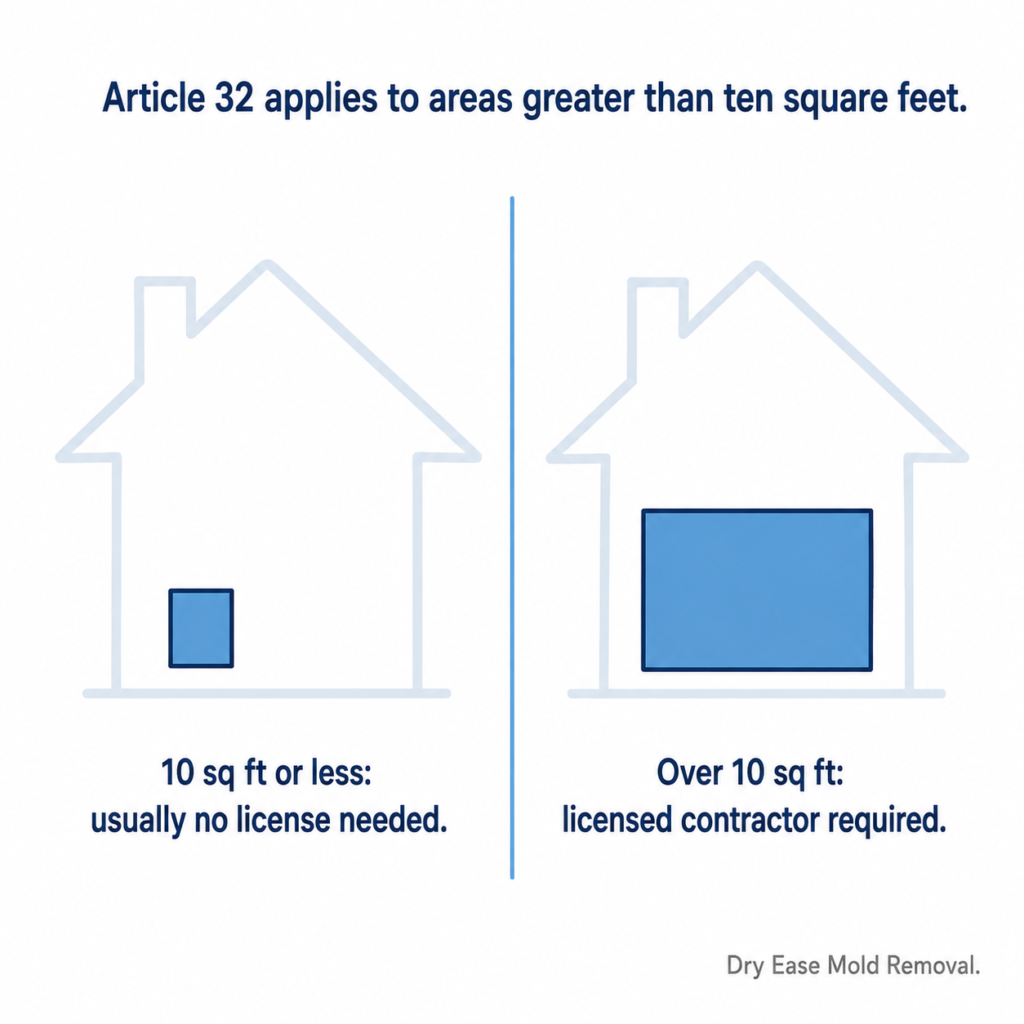
Mold on the paint and grout around a shower is often under the threshold. A small spot can also turn out to involve a much larger area once a contractor opens the wall behind it.
The second question is who does the work. Article 32 exempts a short list of people from needing a license:
- A residential owner working on their own property.
- An owner of commercial property or a residential building with more than four units, working on a building that owner owns. A managing agent for that owner is covered too, and so are the full-time employees of either the owner or the managing agent, but that coverage stops if the managing agent or the employee is in the business of doing mold work for other people.
The two questions are answered separately, which is how a job can be over the size threshold and still not need a licensed company. Say the job covers 40 square feet in a building you own, and your own full-time maintenance staff does the work. The exemption applies, and no license is required.
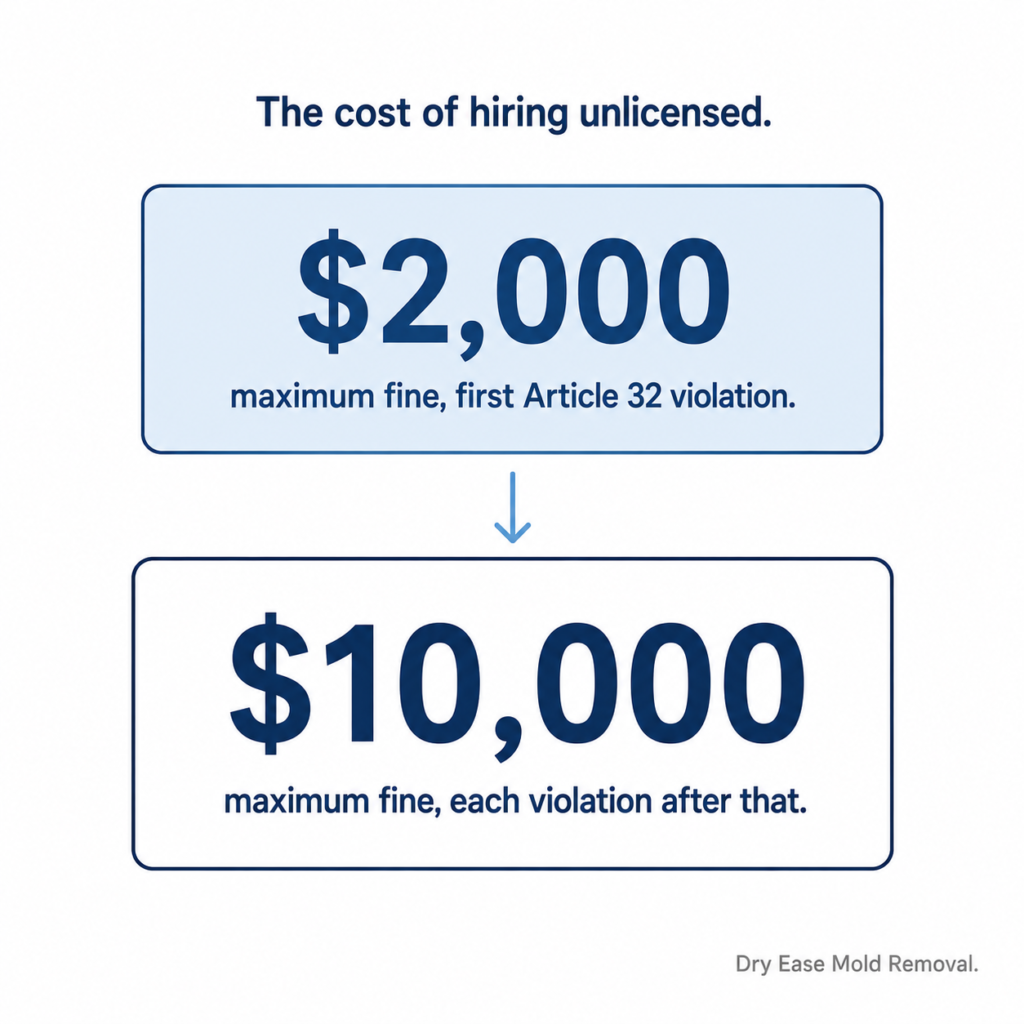
If you own or manage a New York City building and you are hiring an outside company for a job over ten square feet, that company needs the license. The exemptions cover you and your own staff doing the work. They do not cover hiring someone unlicensed, so a handyman, a general contractor without a mold license, and a cleaning company are all out. The penalty for an Article 32 violation runs up to $2,000 for a first violation and up to $10,000 for each one after that.
How to check a mold license yourself, step by step
Here are the steps in order. It takes a few minutes and costs nothing.
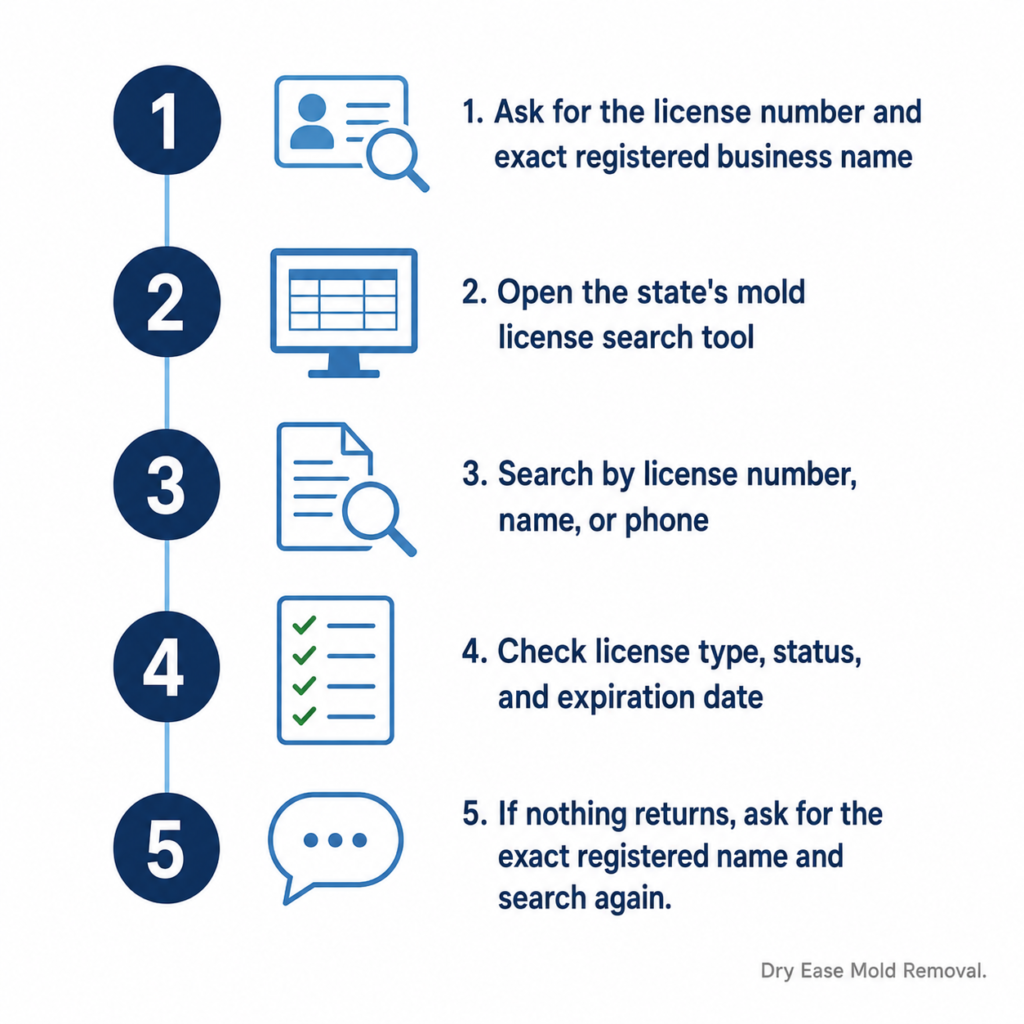
Step 1: Ask for two things, not one. Ask for the license number, and ask for the exact business name the license is registered under with the state. Plenty of companies operate under a trade name that differs from their legal registered name.
Step 2: Open the state’s license records. The Department of Labor’s mold program page has a link labeled “Licensed Mold Contractors Search Tool,” which sends you to New York’s open data site. The mold records live in two files there, one for business licenses and one for licenses held by individual people. You want the business file, since that is where mold assessment contractors and mold remediation contractors appear. Both files are titled “Four Year Window,” meaning they hold recent records rather than every license the state has ever issued.
Step 3: Search. The records are laid out as a searchable table rather than a form with a single box for a license number. You type into the search or filter box, and you can search by license number, business name, address, or phone number. If you were given the license number, search that, because it is the most exact match. If a name search fails, try the company’s phone number.
Step 4: Read four fields on the record. License type should read Mold Remediation Contractor License if you are hiring for removal work. Status should read Active. Expiration date should be in the future, and if the license expires partway through your project, ask the company what happens when it expires. Business name and address should match the company you have been talking to.
If the status reads anything other than Active, or the expiration date has already passed, that company is not currently licensed for the work. Ask them for a current license number and search again before you go any further.
The same file and the same steps verify a mold assessor, where the license type should read Mold Assessment Contractor License. Both companies are in that one file, so you can compare their addresses and phone numbers and confirm they are not the same operation under two names.
Step 5: If nothing comes back, ask before you assume. A search usually returns nothing because you used a trade name rather than the legal registered name, which is why you ask for both up front. Ask the company for the exact name on the license and search again. If they cannot give you a name and number that returns an active record, do not hire them.
The lookup covers the license itself: type, status, dates, and business details. It confirms that a company is licensed and current for the work you are hiring it to do.
Can one company test your mold and then remove it?
No. Under Article 32, no licensee may perform both mold assessment and mold remediation on the same property, and no one may own an interest in both companies on that property. The law contains no exception.
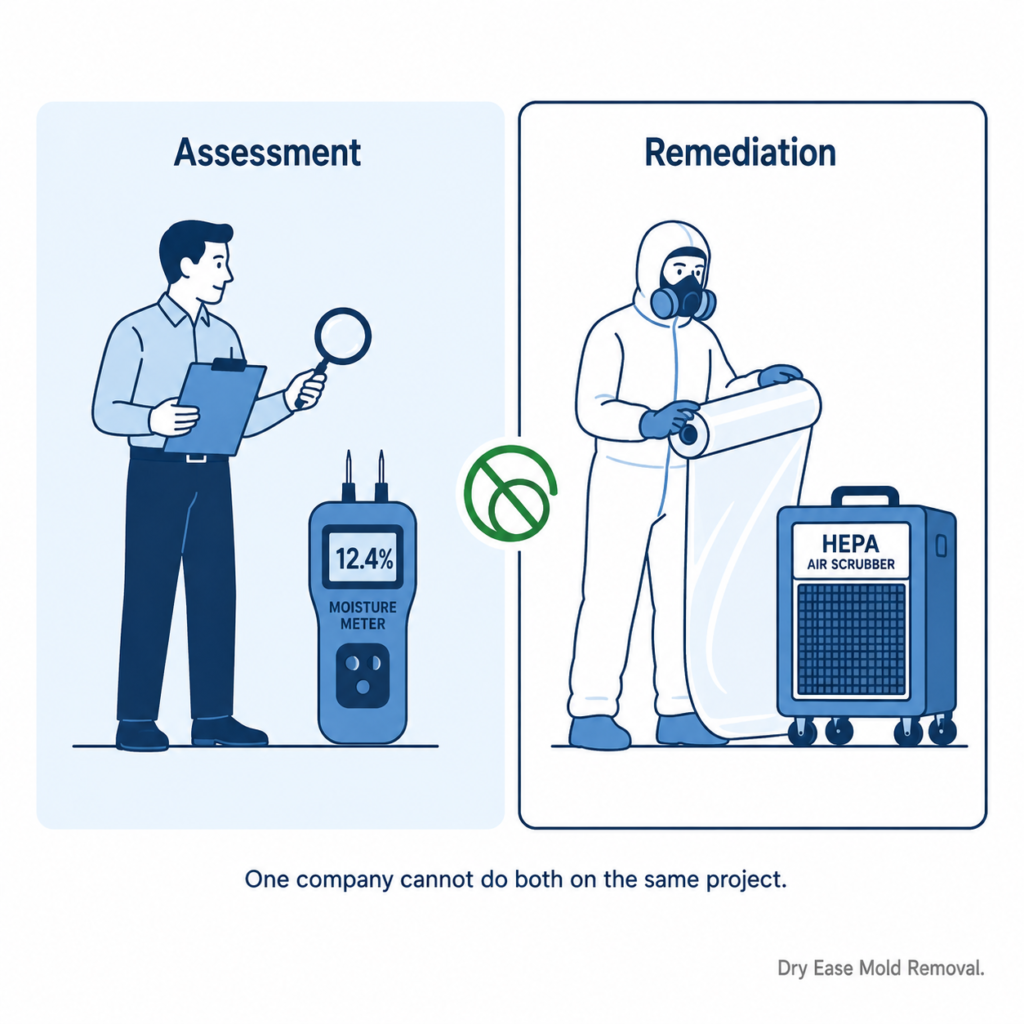
There are two reasons for the rule, and both of them protect you. The company that writes your remediation plan decides how much work gets done, so it should not be the company getting paid to do that work. The other reason is that no company should sign off on its own work. Someone has to confirm at the end that the removal was done properly, and the law does not let that be the crew that did it.
So a compliant New York City mold project has two licensed companies on it. A licensed assessor inspects and writes the remediation plan. A separately licensed remediation contractor writes a work plan matching that scope and does the removal. Then the assessor returns for clearance, because the company that did the removal work cannot issue its own clearance report. The Department of Labor’s own guidance for property owners says to verify both companies’ licenses before hiring either one.
If a company offers to test your mold and then remove it on the same job, that offer conflicts with the state rule. The cost to you is that the paperwork at the end may not be accepted by an insurer, by HPD, or by a buyer’s attorney.
Which company do you call first?
Dry Ease provides mold remediation, not mold assessment. On a job we are quoting, we do our own walkthrough and moisture readings to scope the removal work, which is how we know what containment and equipment the job needs. That walkthrough produces an estimate, and it is not the assessor’s plan.
Which company you need first depends on the size of the affected area. If the mold covers more than ten square feet, your job is a project under Article 32, which means a licensed assessor has to inspect it and write the remediation plan before any removal begins. A remediation contractor’s walkthrough does not substitute for that plan. At ten square feet or under, Article 32 does not apply at all, so the law does not require any paperwork. A contractor’s walkthrough and written estimate is what you should expect to get anyway.
That makes the assessor the first call on anything over ten square feet. We work alongside independent licensed mold assessors on projects that need one. If you cannot tell how big your affected area is, call us and describe what you are looking at. We will tell you whether your job needs an assessor before we quote it.
The state license and the NYC landlord rules are two different things
These two get confused constantly, so here is the difference. The state license decides who is allowed to do the work. New York City’s housing rules decide what a building owner has to do about mold, and how fast.
There is no separate New York City mold license. The city’s mold rules point back to the state Article 32 license, so that is the only license credential you have to check.
The city rule is Local Law 55 of 2018, the Asthma-Free Housing Act. If you own a residential building with three or more dwelling units, you have to inspect units once a year for indoor allergen hazards, mold included, and respond when a tenant or HPD reports a problem. Conditions you find have to be fixed. For buildings with ten or more units, the city’s rules point to the same two state licenses: a mold job over ten square feet has to be handled by a state-licensed assessor and a separately licensed remediator. The state license requirement itself is not limited to buildings that size. If you are hiring an outside company for a job over ten square feet, a four-unit building needs the same two licensed companies that a forty-unit building needs. A tenant who does not get a response from you can report the condition through 311, and that is usually what starts an HPD inspection.
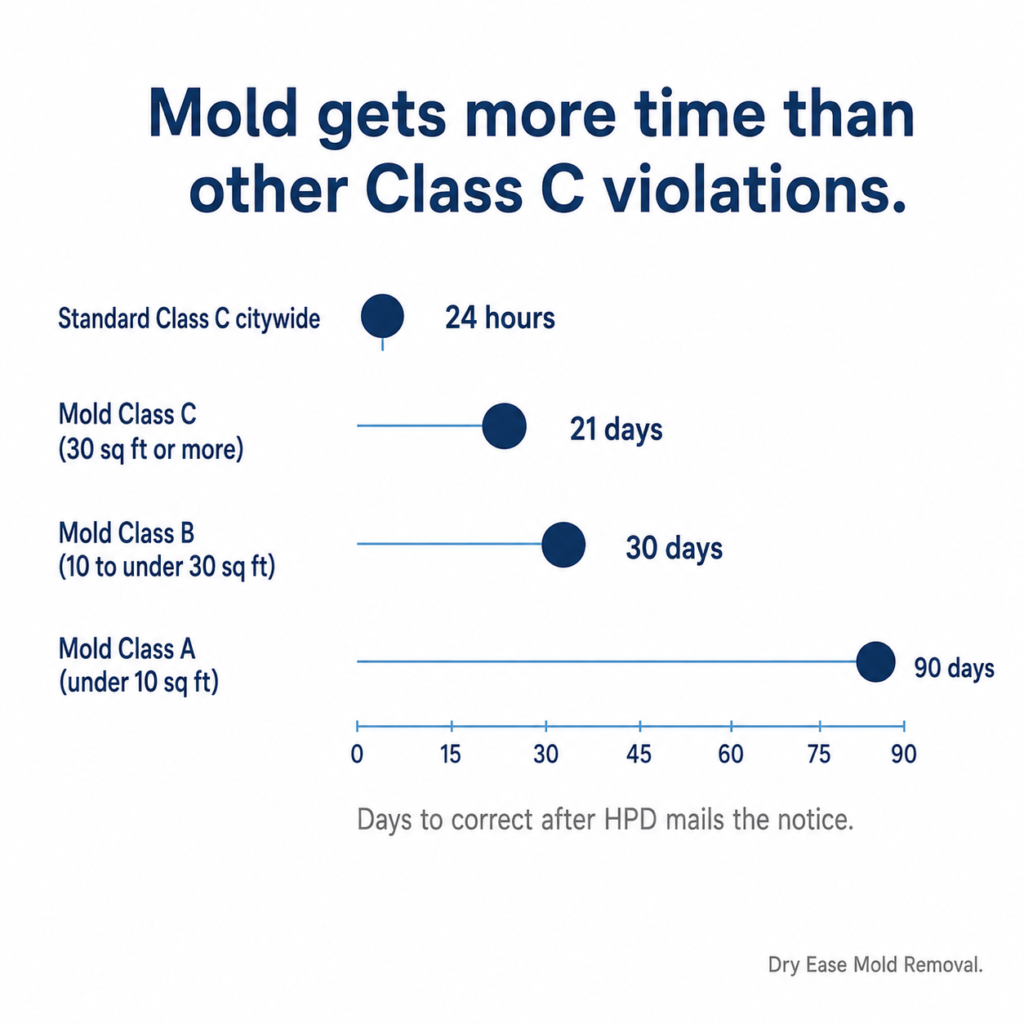
Once HPD issues a mold violation, the class of the violation sets your deadline:
| Violation class | Visible mold in a room inside a unit | Time to correct |
|---|---|---|
| Class A, non-hazardous | Under 10 sq ft | 90 days |
| Class B, hazardous | 10 to under 30 sq ft | 30 days |
| Class C, immediately hazardous | 30 sq ft or more | 21 days |
The correction periods run from when HPD mails or serves the notice, so count from the date on the notice itself.
The 21 days is the number people get wrong. Class C violations across the city normally carry a 24 hour correction period, but mold is treated differently and gets 21 days. That is still not much time. When you call contractors, say you have an HPD violation with a deadline and ask directly whether they can finish the work and get you a clearance report before that date.
One more piece of city paperwork applies only to larger buildings. NYC’s mold work rule for covered buildings applies to buildings with ten or more dwelling units, or buildings on a zoning lot with 25,000 square feet or more of non-residential floor area. For those, your licensed remediation contractor has to notify the city’s administering agency at least two business days before work starts, and your licensed assessor has to submit the post-remediation assessment results within seven days of completion. Tell any contractor how many dwelling units your building has, and ask whether anything has to be filed before work starts. The code calls the recipient the city’s administering agency, and the city has designated the Department of Environmental Protection (DEP) for this role, so the pre-work notice and the post-remediation filing go to DEP. Then ask for two documents: a copy of the pre-work notice from your contractor, and a copy of the post-remediation filing from your assessor.
What the state license does not prove
A license means the state confirmed a company met the requirements to do this work. It does not tell you whether the company’s insurance is current, how its crews are trained, or what paperwork you will be holding at the end. All three are things you can check yourself.
Insurance
To hold either mold license, a company has to show the state liability insurance of at least $50,000 covering the licensed work. Ask for the certificate of insurance itself and check the two things on it you can actually verify: that the policy dates cover your project, and that the named insured matches the company on the license record. Ask for proof of workers’ compensation too, since New York requires nearly every employer in the state to carry it and that is the coverage that matters if someone gets hurt on your property.
Certification and the standard behind the work
The license is what legally allows a company to do mold remediation in New York. IICRC certification is about training. An individual technician can be certified, and so can a whole firm, which means the company employs certified technicians and signed the IICRC code of ethics. Ask which one a company is claiming, because companies blur the two in their advertising.
The procedures come from ANSI/IICRC S520, the standard for professional mold remediation. Ask how the work area will be contained and whether the crew is running negative air. Containment means sealing the area off with plastic sheeting and covering the paths in and out. Negative air means running HEPA filtration that pulls air out of the sealed area, so spores do not spread into clean parts of the building while materials are coming out.
Correcting the underlying cause of the moisture is generally the property owner’s responsibility, not the remediator’s. Ask whether fixing the leak is in the contractor’s scope or yours, and settle that before the work is scheduled. If water is still getting in, mold can come back no matter how well the removal was done.
The plans and the clearance report you should receive
Article 32 requires written plans from both license holders. The assessor’s mold remediation plan comes first, and it has to be in your hands before remediation begins. The law requires it to name the rooms where work will happen, the quantities of material coming out, the methods, the clearance criteria, how occupants get notified, and an estimated cost and timeframe. Your remediation contractor then writes its own work plan, which has to satisfy everything in the assessor’s plan. A verbal quote, or a plan from one company and nothing from the other, means the job is not being run the way the law requires.
The job is also not finished when the crew packs up. The licensed assessor returns and conducts a post-remediation assessment confirming that the work area is free of all visible mold, that the work matched the plan, and that the underlying cause was addressed. If it passes, the assessor issues a written passed clearance report. If it does not, you and the remediation contractor get a final status report explaining what still has to happen.
Keep the whole file: both written plans, the passed clearance report, the itemized scope and invoice, the certificate of insurance, and, for covered buildings, the two city filings. Our own reporting covers what we removed, the moisture readings we took, and our recommendations for preventing recurrence. The clearance report is a separate document, and it comes from the assessor.
Credentials and documents to check, and how to verify each one
| What to check | What it proves | Where to check it |
|---|---|---|
| Mold remediation contractor license | Legal to do the removal | State business file: type and status |
| Mold assessment contractor license, different company | Independent plan and clearance | Same file; compare the two companies’ addresses and phone numbers |
| Certificate of insurance | Coverage in force for your job | The certificate: policy dates, named insured |
| Assessor’s remediation plan | Scope in writing before work starts | The assessor, before the crew arrives |
| Contractor’s work plan | Crew instructions match the scope | The contractor, before site prep |
| IICRC certification | Trained to industry practice | Ask: firm or individual technicians |
| Passed clearance report | Job finished to the plan | The assessor at the end, never the remediator |
| Pre-work notice and post-work filing | City paperwork done, covered buildings only | Contractor for the notice, assessor for the filing |
Licensing is one part of this decision. We covered the rest in our guide on how to find a trustworthy mold remediation company in New York.
Frequently asked questions
What happens if I hire an unlicensed contractor for mold removal?
New York can fine violations of Article 32 up to $2,000 for a first violation and up to $10,000 for each violation after that, assessed by the Commissioner of Labor after notice and a hearing. The work itself may also have to be redone by someone licensed.
How do I know whether a mold estimate is fair?
Read the estimate against the written scope: which rooms, how much material is coming out, what methods and equipment, and whether fixing the moisture source is in the price. Two estimates are only comparable when they describe the same scope, and an estimate with no line items cannot be compared to anything. We break down what drives the numbers in our mold remediation pricing guide for New York City.
Do co-op and condo boards have to follow the same rules?
Yes. The state license requirement and the city’s rules apply based on the building and the size of the job, not on how it is owned. Who pays for work inside a unit versus in a common area is not set by the mold laws, so that answer comes from your governing documents and your managing agent.
Talk to a licensed NYC mold remediation contractor
If you are looking at mold in a New York City building right now and you want a licensed remediation contractor who handles HPD violations and insurance documentation routinely, call us at (877) 215-8399 or send a message through our contact page. We will look at what you are dealing with and give you a written scope you can compare against any other quote. Our owner, Rob Gershman, has over 20 years in the field and handles complex and commercial estimates himself. The site visit and the estimate are free, and if the answer is that you do not need us, we will tell you that too.