
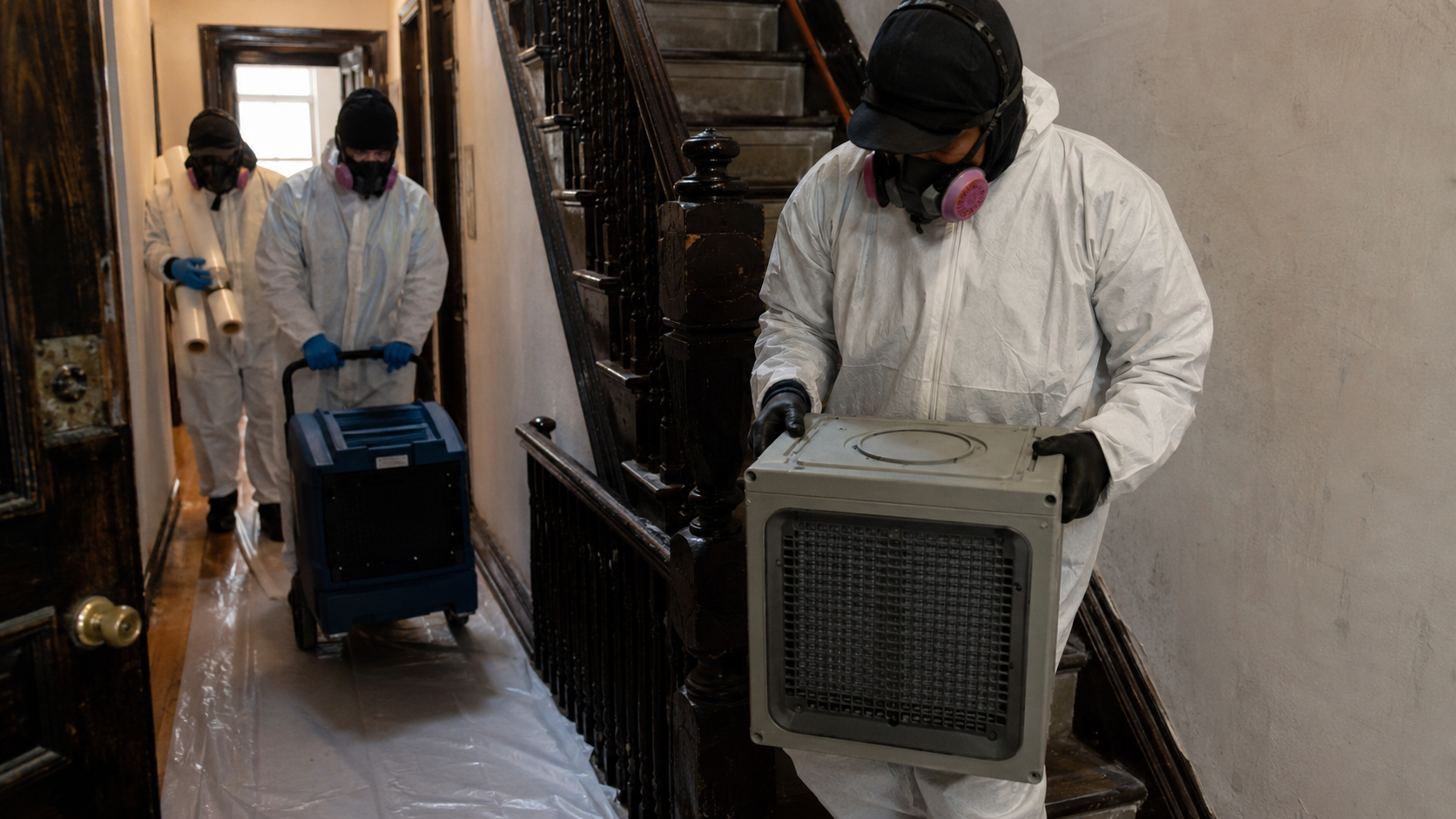
Written from the field by Dry Ease Mold Removal, a NY State licensed Mold Remediation Contractor (License #26-6AXK6-SHMO, exp. 5/31/2028) serving the five boroughs, Westchester, Nassau County, and North Jersey for 20 years. Our technicians hold IICRC certifications in Applied Microbial Remediation (AMRT) and Water Damage Restoration (WRT). You can verify any NY mold contractor’s license through the state’s Licensed Mold Contractors Search Tool before hiring.
The Short Answer
The mold itself doesn’t change. A commercial office and a residential apartment can grow the exact same species off the exact same kind of leak. What changes is almost everything around it: when we’re allowed on site, how much space we section off, how long the problem usually sits before anyone picks up the phone, what’s actually inside the walls, and who we end up coordinating with to get the job closed out.
Residential jobs are usually faster to start and tighter in scope, but they demand more careful containment because someone is living there day to day. Commercial jobs give us more physical room to work, but the access windows are narrower, the call often comes in later than it should, and there’s more paperwork behind the scenes. Below is what actually separates the two, based on jobs we’ve run in both categories across the five boroughs, Westchester, Nassau County, and North Jersey.
The Core Differences at a Glance
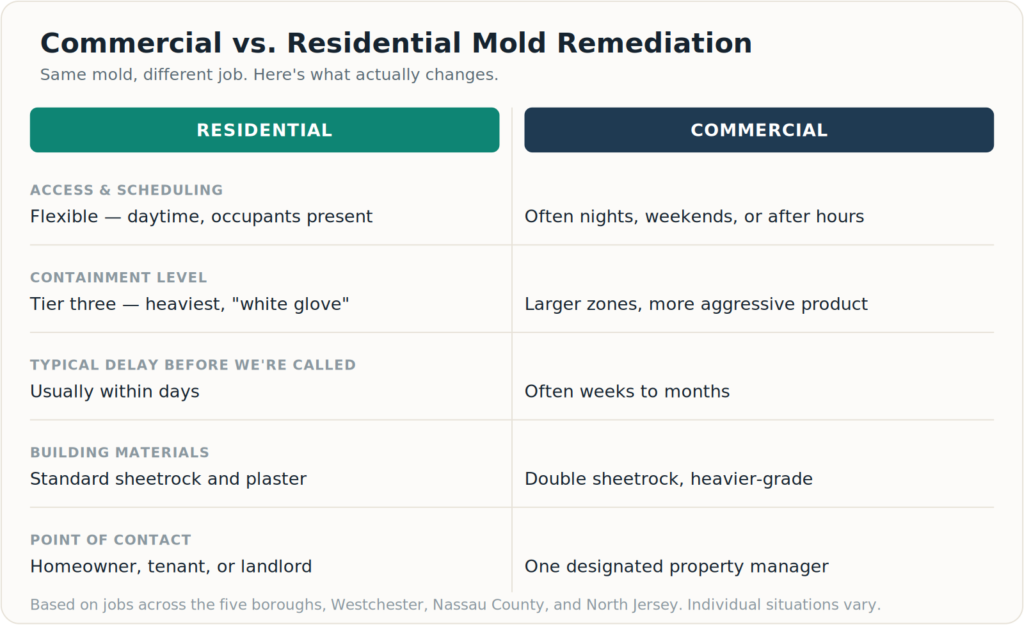
Here’s how the two compare across the factors that move your timeline and your invoice the most:
| Factor | Residential | Commercial |
|---|---|---|
| Access & Scheduling | Flexible, daytime access; occupants often present | Frequently limited to nights, weekends, or after hours |
| Containment Approach | Tier three: heaviest containment, most disinfectant, full HEPA vacuuming | Larger containment zones; more aggressive disinfectant where occupancy allows |
| Typical Delay Before the Call | Usually within days of discovery | Often weeks to months while approvals get sorted out |
| Building Materials | Standard sheetrock and plaster | Frequently double sheetrock, heavier industrial-grade material |
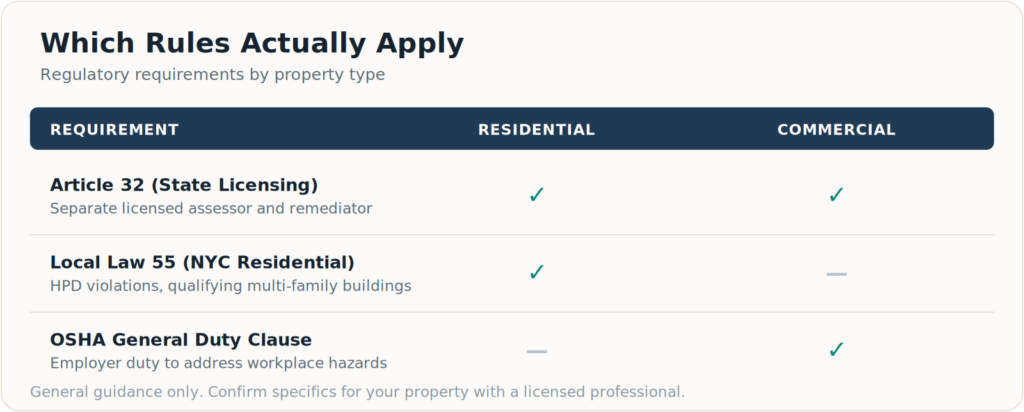
| Licensing Requirement | Article 32 applies; Local Law 55 applies to qualifying multi-family buildings | Article 32 still applies; Local Law 55 does not, OSHA’s General Duty Clause does |
| Primary Point of Contact | Homeowner, tenant, or landlord | Ideally one designated property or facilities manager |
Access and Scheduling
Why Commercial Jobs Often Happen After Hours
In a residential unit, someone usually lives there, so we work around a person’s schedule but we’re still generally allowed in during the day. Commercial space is different. Most buildings we work in are used during business hours by employees, customers, or patients, and building management doesn’t want a remediation crew, containment barriers, and equipment showing up in the middle of a workday. It creates alarm. Nobody wants staff walking past a crew in full suits with gear labeled “mold” while they’re trying to get through a Tuesday.
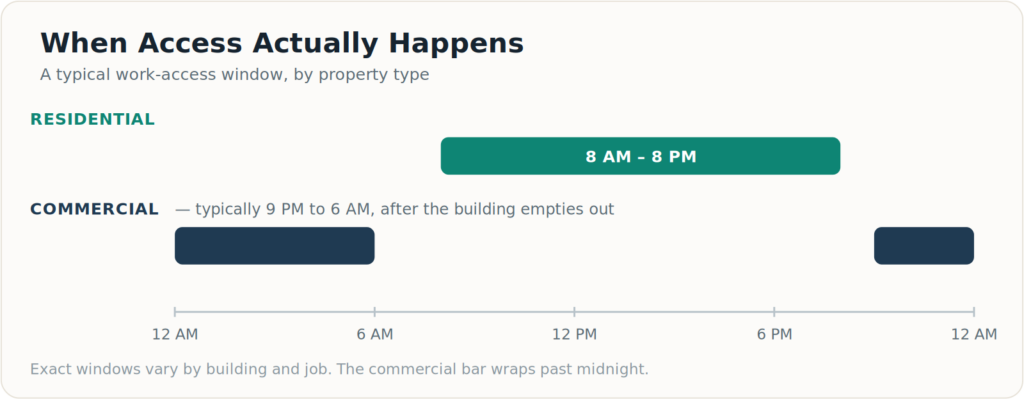
So the work usually happens after the building empties out: nights, weekends, or specific windows building management carves out for us. That access almost always has to be arranged in advance with property management or building ownership, and it’s not unusual for their porters or security staff to be put on overtime just to let us in and lock up behind us.
Here’s roughly how that plays out on the clock:
Does Working After Hours Extend the Timeline?
Sometimes. If we’re limited to a five or six hour window overnight instead of a full working day, a job that would take three straight days of daytime work can stretch out over a week of overnight sessions. The actual hours of labor aren’t that different, they’re just spread across more calendar days.
When a client wants to keep the calendar tight, we bring in more crew for those overnight windows and compress the same amount of work into fewer nights. That’s a real trade-off: more staff on site at once costs more, but it protects the timeline. It’s a conversation worth having up front with any commercial client, because the choice between a longer calendar and a bigger crew changes the cost either way.
Containment: Tier Three vs. a Bigger Working Zone
Containment is where the residential and commercial approach really splits.
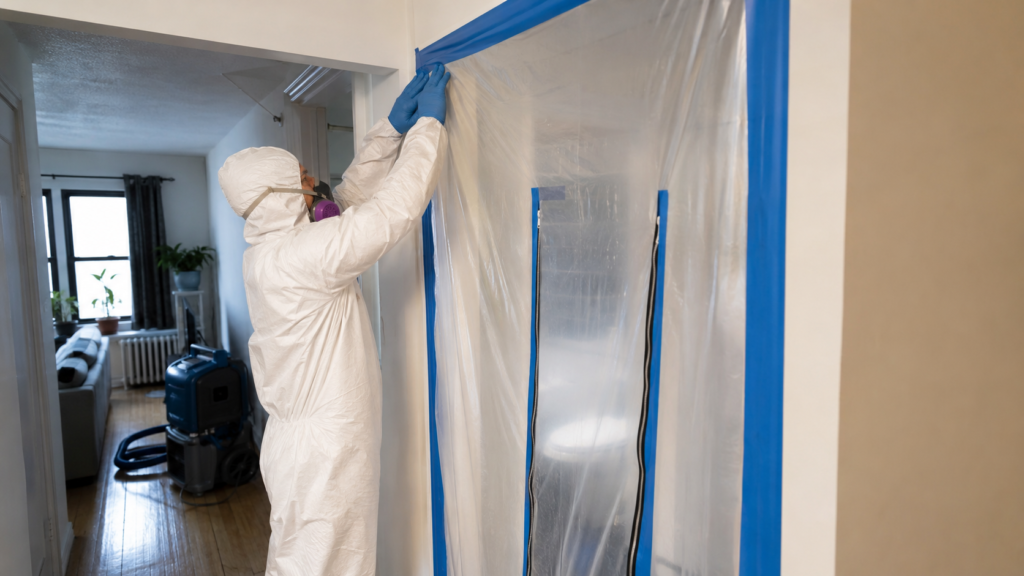
In an occupied home, we build what we consider tier three containment: the heaviest version of what we do. That means full poly sheeting, negative air pressure, more disinfectant, more HEPA vacuuming, and a level of dust prevention that leaves the rest of the home genuinely untouched. We think of it as a white glove job, because someone is going to be sleeping in the room next door, and the containment has to be airtight enough that it doesn’t matter.
Commercial buildings, especially the ones we access after hours with no one on site, give us more physical latitude. Our containment zones tend to be bigger, because we’re not working around furniture and family members, and we can use more aggressive disinfectant products since we don’t need to worry about someone walking back into a treated space an hour later. That doesn’t mean commercial containment is careless. It’s still sealed, still under negative pressure, and still built to keep spores from spreading into the rest of the building. It’s just built for a different set of constraints. Our mold removal process stays consistent either way; what changes is the footprint we build it around.
Why Commercial Jobs Are Often Bigger by the Time We Arrive
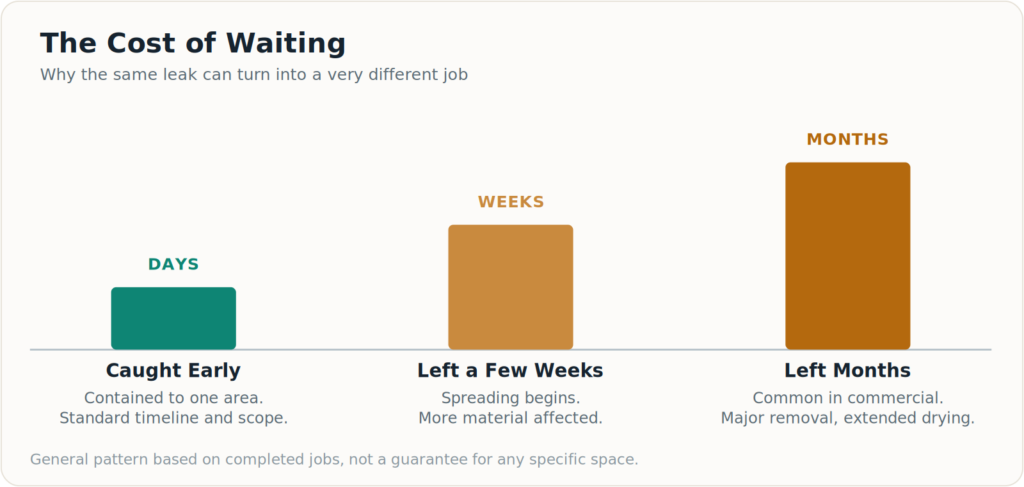
The mold species we find in a commercial building isn’t any different from what we find in an apartment. What’s different is how long it’s usually been growing before anyone calls us.
A homeowner or tenant living with water damage tends to deal with it fast, because they notice it every day: the smell, the stain on the ceiling, the damp carpet underfoot. Commercial spaces don’t work that way. A leak in a back office, a storage room, or a section of a building that isn’t actively used can sit for weeks or months while staff wait on a vendor, wait on management sign-off, or simply don’t notice it because nobody’s in that part of the building regularly.
By the time we’re finally called in, that delay shows up directly in the scope of the job. There’s more material to pull out, our structural drying equipment has to run longer because the moisture has had more time to work its way into the structure, and what might have been a contained, three-day job if it were caught early turns into something bigger. This is the single biggest reason a “similar sized” commercial and residential job can end up on completely different timelines: it’s rarely about the space itself, it’s about how long the problem sat before we got the call.
The pattern looks roughly like this:
Building Materials and the Cost Difference
Commercial buildings are also just built differently, and that affects both time and cost. Most of the commercial spaces we work in use double sheetrock on interior walls and heavier, more industrial-grade building material generally, compared to the single-layer sheetrock and plaster common in residential units. That heavier material takes longer to cut through, weighs more to haul out, and often means we need more staff on site to move debris safely and keep the job on schedule.
Add that to the after-hours labor and the longer drying windows that come from a delayed call, and it’s usually why a commercial job comes in more expensive per square foot than a similarly sized residential one. It’s not that we’re charging more for the same work. It’s genuinely more work.
Regulatory Differences: What Actually Applies to Commercial Space
New York has real licensing law behind mold work, but not all of it applies the same way to commercial buildings.
New York’s Article 32 licensing law requires anyone performing mold assessment or remediation on a project over 10 square feet to be separately licensed, and it requires the company doing the assessment to be different from the company doing the remediation. This applies across the board, commercial and residential alike. There’s no carve-out for office buildings or retail space. If you’re a property manager hiring for a commercial job, you should still expect, and should still insist on, separately licensed assessment and remediation contractors. You can confirm any contractor’s license through the state’s Licensed Mold Contractors Search Tool.
What doesn’t carry over is Local Law 55, which is written specifically around residential dwelling units and HPD violations in qualifying multi-family buildings. It has no commercial equivalent, so a commercial landlord isn’t dealing with the same HPD violation timeline a residential building owner might face.
What commercial space does have to reckon with is OSHA. There’s no mold-specific OSHA standard, but the agency’s General Duty Clause requires employers to keep a workplace free of recognized hazards, and mold growth left unaddressed can qualify. It’s a lower-profile requirement than Article 32 or Local Law 55, but it’s real, and it’s one more reason commercial property owners shouldn’t sit on a known mold problem.
Here’s the same information as a quick reference:
Coordination: Who You’re Actually Talking To
In a residential job, we’re usually coordinating with one person: the homeowner, the tenant, or occasionally the landlord. In a commercial job, that list gets a lot longer. We might be coordinating with a property manager, a facilities director, building security for after-hours access, and sometimes tenants in neighboring units who need to know work is happening nearby.
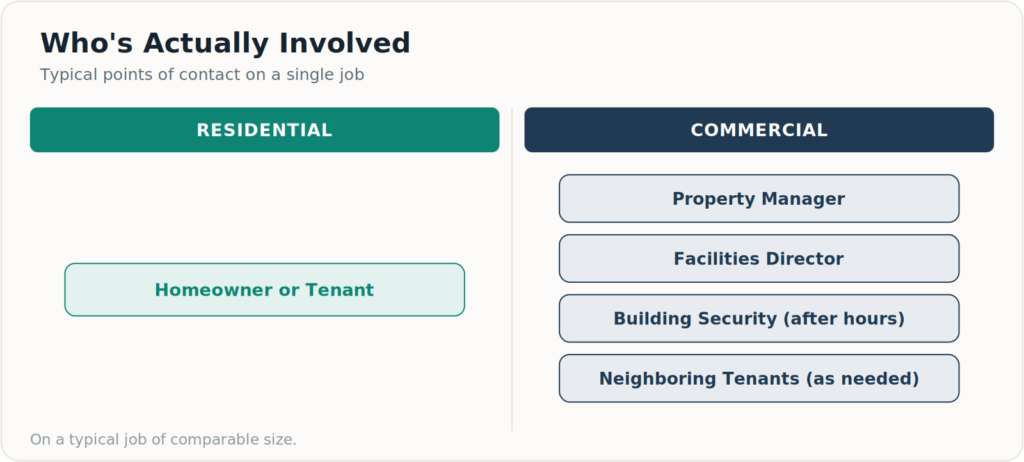
That adds real logistical weight. Staging areas for equipment and materials are often set up much farther from the actual work zone than they would be in an apartment. We’re frequently moving through freight elevators, loading docks, and long stretches of hallway just to reach the space, and all of that has to be scheduled around the building’s own operations.
It also adds administrative overhead. More people involved generally means more people asking questions, and if those questions are going to five different people instead of one, we end up answering the same question multiple times while the job sits waiting to start.
Our advice to every commercial client: designate one person, ideally your most experienced property or facilities manager, as the single point of contact with your remediation company. Let that person field every question and relay decisions to whoever else needs to know. It sounds like a small thing, but repeated, disconnected communication is one of the most common reasons a commercial start date slips.
A Real Commercial Job: An After-Hours Office on Sixth Avenue
A recent example: an office on Sixth Avenue in Manhattan needed mold remediation, and building access was only available after hours. We started work at 9 PM, and building management put porters and staff on overtime specifically to get us in and out safely.
The job itself also required more staging than a typical residential walk-up. Instead of carrying equipment up a stairwell into an apartment, we moved through the building’s freight elevators and walked materials and gear through roughly half a block of office space to reach the actual work area. None of that is unusual for a commercial job in a large Manhattan building, but it’s the kind of logistics that simply doesn’t come up in a residential unit, and it’s built into how we plan and staff a commercial project from the start.
What This Means for Your Timeline and Budget
If you’re a property manager or facilities director dealing with mold for the first time, here’s the practical takeaway: don’t compare a commercial quote to a residential one and assume something’s wrong if the number or the timeline looks bigger. Bigger containment zones, after-hours labor, heavier building material, and a longer stretch of unaddressed water damage before the call came in are all real cost and time drivers that residential jobs usually don’t carry to the same degree.
The one lever you do control is how fast you call once you know there’s a problem. Every factor above gets worse the longer a leak or a damp area sits unaddressed, and a job caught in its first week almost always costs less and takes less time than the same job caught two months later. For a general sense of how job size affects timeline once remediation actually starts, our breakdown of how long mold remediation typically takes covers that in more detail.
FAQ
Is commercial mold remediation more expensive than residential?
Usually, yes, per square foot. Heavier building materials, after-hours labor, and larger containment zones all add cost that a typical residential job doesn’t carry.
Does New York require a licensed mold assessor for commercial buildings?
Yes. Article 32 requires separately licensed assessment and remediation contractors for any project over 10 square feet, and that applies to commercial space the same as residential.
Can a business stay open during mold remediation?
Often, yes, especially for smaller jobs contained to one area. That’s part of why after-hours and weekend scheduling exists: it lets a business keep operating during the day while remediation happens when the space is empty.
Why do commercial mold jobs often take longer to start than residential ones?
Water damage in commercial buildings tends to sit longer before anyone notices it or gets vendor approval to act on it, which means more damage has usually spread by the time remediation actually starts.
Is the mold itself different in a commercial building?
No. It’s typically the same species you’d find in a home. What differs is the scale of the problem and how long it’s been growing.
What’s the fastest way to keep a commercial mold job on schedule?
Designate one point of contact on your side, and call as soon as you know there’s a moisture problem rather than waiting on approvals. Both of those, more than anything else, determine how fast a commercial job moves.
Bottom Line
The mold doesn’t know the difference between an office and an apartment. The job does.
Commercial remediation usually means tighter access windows, bigger containment zones, heavier building material, and more people to coordinate with, and residential remediation usually means faster starts with a more careful, contained approach because someone’s living there. Either way, the fastest and cheapest path through a mold problem is the same: call as soon as you find it.
If you’re managing a commercial property or dealing with mold in your home anywhere in the five boroughs, Westchester, Nassau County, or North Jersey, call Dry Ease Mold Removal at (877) 215-8399 or request a quote online. We’ll tell you honestly what you’re looking at before we start.